 digest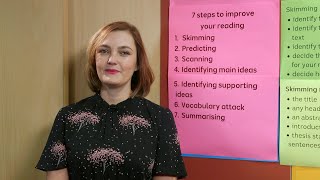
Short Summary
Main recommendation: Use a seven-step academic reading process (skimming, predicting, scanning, identifying main ideas, identifying supporting ideas, vocabulary attack, and summarising) to decide whether a text is worth reading and to understand it more deeply. The video applies these steps to a sample article on ways to reduce stress and improve mental health.
Key Points
- Skimming means reading quickly to identify the topic, main ideas, genre, and whether the text suits your study purpose, which helps you decide if a long reading list item is needed for an assignment.
- Predicting uses what you already know about the topic, plus what you want to learn, to guess the text's contents and usefulness before reading in depth.
- Scanning means searching for specific keywords or symbols without reading every word, and marking what you find so you can locate it quickly later.
- Supporting ideas are the evidence and examples that back up the writer's main ideas, often flagged by signposting language such as "for instance" or "the first benefit is."
- Building a vocabulary journal of new words helps English learners retain them, and using each new word in a sentence within the first week makes it more familiar.
Details Worth Noting
- Concrete instructions: Skim by reading titles, subheadings, the abstract (if present), the introduction and conclusion, and thesis statements and topic sentences. While scanning, underline or circle keywords. To identify main ideas, underline key terms, annotate in the margins, then write the main ideas in your own words. For vocabulary, note each new word, its translation into your language, its definition, and its part of speech, then write a sentence using it. After reading, summarise the main concepts, findings, and results in your own words, and compare your ideas with a classmate.
- The sample article, "Five Ways to Enhance Your Mood and Mental Health," has five headings: improve your diet and start moving, reduce your vices, prioritise sleep and get some rest, get a good dose of nature, and reach out when you need help.
- In the example, key terms spotted during scanning included "improve mood," "reduce stress," and "manage mental health," which confirmed the article matched the essay topic.
- If the text is not useful after skimming, predicting, and scanning, the speaker suggests stopping and moving to the next item on the reading list.
- The speaker recommends reading English for pleasure and practising skimming and scanning on online articles to build reading skill.
Bottom Line
The seven steps work as a filter: quick skimming, predicting, and scanning tell you early whether a text deserves full, careful reading.



