 digest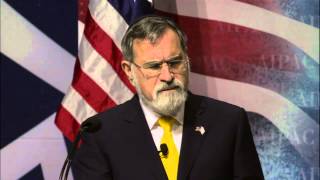
Short Summary
Main recommendation: Rabbi Lord Jonathan Sacks, speaking at AIPAC, calls on Jewish communities across Europe to emulate AIPAC's example of standing up for Israel, arguing that anti-Zionism has become the new anti-Semitism and that Israel's survival is tied to the future of freedom. He frames support for Israel as support for life, citing Israeli hospitals, schools, and youth villages as evidence.
Key Points
- Sacks says anti-Semitic incidents are rising in Europe, citing increases of 58 percent in France in a single year, 30 percent in Belgium, and a doubling in Denmark over three years.
- He argues that Jews were once hated for their religion, then their race, and now their state, claiming "the reason changes, but the hate stays the same."
- He contends that criticism of Israel is not automatically anti-Semitic, but that anti-Zionism functions as anti-Semitism today.
- He presents Israel's existence as a defining struggle of the twenty-first century between "the will to power" and "the will to life."
- He cites Israel as a democratic model in a hostile region, noting a Palestinian can criticize the government on national television without losing freedom.
Details Worth Noting
- Concrete instructions: No step-by-step instructions are given. The speaker's only actionable call is for Jewish communities in Europe to "stand up and fight, and stand up and win," modeled on AIPAC.
- Sacks describes Israeli institutions he visited, including the Rambam Hospital in Haifa, which is building what he calls the world's largest underground hospital, and the Barzilai Medical Center in Ashkelon, which treats Jews, Muslims, and Christians.
- He recounts the Laniado Hospital in Netanya, built by the Klausenberger Rebbe, a survivor of Auschwitz who lost his wife and eleven children and vowed to dedicate his life to saving lives if he survived.
- He compares Israel's size to Kruger National Park in South Africa and says Israel was described as the Hong Kong of the Middle East, with Hong Kong later aspiring to be the Israel of the Far East.
- He frames Judaism as "the defeat of probability by the power of possibility," citing the Jewish people's survival through ancient empires and return to their land after 2,000 years of exile.
Bottom Line
The speech is a fundraising-style rally message: it blends a warning about rising European anti-Semitism with a celebratory account of Israel's institutions, asking listeners to see support for Israel as a defense of life and freedom.


