 digest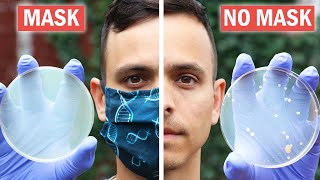
Short Summary
Main recommendation: wear a mask, because in this home and university-lab recreation of a viral Petri dish experiment, masks cut the bacterial droplets released by coughing, sneezing, talking, and singing dramatically. The presenters stress that these results show how well masks stop droplets leaving your mouth (protecting others), not how well they protect the wearer, and that masks are only part of the solution.
Key Points
- Masks reduced visible bacterial colonies to none in the home sneeze, talk, and sing plates, and the University of Toronto lab results matched that pattern.
- The unmasked sneeze produced the most growth, with the presenters estimating maybe 50 little colonies on the home plate.
- Unmasked talking and singing also produced clear colony growth, even though the presenters were not sick.
- The experiment measures droplet output from the speaker, so it reflects protection for others rather than for the wearer.
- The presenters say masks are part of the solution alongside handwashing, physical distancing, isolating after exposure, and eventually vaccines and treatments.
Details Worth Noting
- Concrete instructions: The experiment method was to hold each agar plate about 1.5 feet from the face, cough twice on one plate, sneeze twice (a fake sneeze was used) on another, talk for one minute on another, and sing for one minute on another (the presenter sang "Uptown Girls," reciting "hydrogen and helium, then lithium, beryllium" for talking and singing). The whole set was then repeated with a mask on. Plates were kept in the warmest room at home for one week; the University of Toronto lab used Brucella Blood Agar with sheep's blood, heme, and vitamin K, incubated at 37 degrees Celsius for two days.
- The home plates were LB agar, which favors bacteria; the presenters note that fungus-favoring plates exist but were not used.
- The home plates grew for nearly two weeks, while the lab plates grew for only two days, so the lab was expected to show more species due to richer nutrients and an incubator.
- The bacteria are the commensal, normal everyday bacteria and fungi from the mouth, nose, and throat; the presenters say viruses cannot be seen on plates, so the experiment underestimates total droplet content.
- The presenters cite a study using computers and lasers showing that the "th" sound in "stay healthy" produces many droplets, and that choirs were linked to COVID spread.
- The home-made cotton masks (two cotton fabric layers with elastic) were tested alongside the experiment's conditions.
Bottom Line
Masks markedly reduce the droplets people release when they cough, sneeze, talk, or sing, which mainly protects the people around you, but they work best combined with handwashing and physical distancing.
