 digest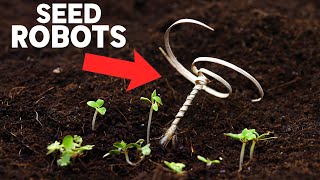
Short Summary
Main recommendation: The video presents a self-propelling wooden robot, inspired by the hygromorphic tail of the Erodium plant, that automatically drills seeds into the ground to help reforest the planet. Its design uses humidity-driven coiling of oak wood, carries seeds up to 75 milligrams, and when tested dropped from drones maintained a 90 percent success rate at the optimized angle.
Key Points
- The robot is built from one single material, oak wood, processed through chemical steps similar to paper-making and then mechanically molded, so no synthetics are required.
- Its motion comes from hygromorphy: the inner wood layer expands and shrinks faster than the outer layer, so it coils when wet and pushes deeper into soil as it dries.
- Natural Erodium seeds have a very low drilling success rate, sometimes zero percent on certain terrains, which motivated the team to design a more efficient structure.
- Three anchor points keep the robot from flipping or falling, so it reliably faces down at a specific angle.
- Burying seeds underground protects them from animals, fire, temperature extremes, and being washed away.
- The design can carry symbiotic species such as beneficial fungi and nematodes, which the team reports improve plant health and survival.
Details Worth Noting
- Concrete instructions: No step-by-step procedure for building or deploying the robot is given. The actionable design parameters are: use oak wood, use a three-anchor-point structure to keep the robot facing downward at a specific angle, and choose the number of coils carefully, since more coils soften the structure while too few lack thrust and actuation. The team's simulations and experiments settled on five coils. Place the robot on the ground so it self-buries, and attach a seed to it for planting.
- The team's trials tested the optimal number of coils, angle of entry, and wood curvature to maximize drilling.
- Wood is fully biodegradable, so it does not leave lasting waste on the forest floor.
- Seed carrying capacity is up to 75 milligrams, compared with 8 to 20 milligrams for typical natural hygromorphic seed tails.
- The concept may extend beyond reforestation, for example to window-mounted actuators that open and close scales in response to outside humidity, illustrated as a random example by the narrator.
- The design is passive: once made, it relies only on natural resources, with no power source needed.
Bottom Line
A low-tech, biodegradable wooden seed-drilling robot could make reforestation more reliable, and its humidity-driven design may also inspire passive, energy-free devices in other fields.