digest
Short Summary
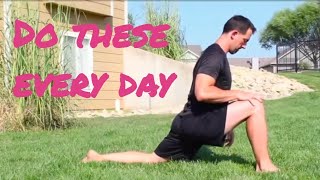
Main recommendation: Do three leg-strengthening exercises (split squats, ankle dorsiflexion/toe raises, and calf raises) at beginner, intermediate, and advanced levels, then repeat the 30-second sit-to-stand test after a week to track progress. The video frames these as a way to address trouble getting out of a chair, which it links to weak legs.
Key Points
- The three promised exercises are: (1) the split squat, (2) the anterior tibialis toe raise, and (3) the calf raise.
- The exercises are presented as suitable for both beginners and advanced individuals, need no gym, weights, or bands, work each side equally, and can be done in about five minutes.
- Difficulty is progressed by adding support, range of motion, or external weight rather than buying equipment.
- The 30-second sit-to-stand test is presented as a self-check of leg strength compared with age-group averages.
- People who cannot stand without using their arms score zero, which the speaker says does not mean they are "a zero"; the test is meant to be repeated after a week to show improvement.
Details Worth Noting
- Concrete instructions:
- Split squat, beginner: Stand holding the back of a chair or countertop, one foot forward and one back. Lower slowly, then rise. Do 10 with the left leg forward, then 10 with the right leg forward.
- Split squat, intermediate: Hold a stick or cane for balance. Go through the full range of motion, lowering the back knee toward the floor (a pillow can cushion a sensitive knee). Do 10 per side with control.
- Split squat/lunge, advanced: Hold a weight such as a duffel bag filled with items you can securely grip. Perform lunges with good posture, 10 per side.
- Toe raise (anterior tibialis), beginner: Start seated and do about 20 repetitions, spread across the day (morning, midday, evening).
- Toe raise, advanced: Stand about 12 inches from the wall with your buttocks and back against it, then pull toes up as far as possible and back down. Move feet farther from the wall to increase difficulty, closer to decrease it. Keep knees locked and do 10 repetitions. Wear shoes that grip, and hold a cane or chair for support.
- Calf raise, beginner: Start seated, lift heels and rise onto toes slowly and with control, starting with 10 and working up to 20.
- Calf raise, intermediate/advanced: Hold a countertop or solid support, feet shoulder-width apart, and rise onto toes for 10 repetitions. Progress by using stairs with the ball of the foot on the step and heels dropping below the step for a calf stretch. Wear rubber-soled shoes. Avoid carpeted steps where feet may slide.
- 30-second sit-to-stand test: Use a sturdy armless chair with a seat height of about 17 inches, placed against a wall for stability (the speaker's chair was slightly taller, and they say to use the same chair for repeat tests). Sit toward the back with a straight back, feet shoulder-width apart, wrists crossed and hands on chest. Stand fully with straight knees, then sit in a controlled manner, counting only full stands, for 30 seconds. Stop early if too tired and record the number reached. Compare against the age-group chart, then repeat after a week.
- The speaker notes a range of averages in the chart rather than a single number.
- Some people may never reach the advanced calf-raise stretch level, which is described as very challenging.
- The video suggests this sequence works well for people with weak legs, with the test providing a before-and-after measure.
Bottom Line
Regular, controlled practice of these three exercises, measured by repeating the sit-to-stand test after a week, is the video's recommended way to build the leg strength it links to difficulty rising from a chair.