digest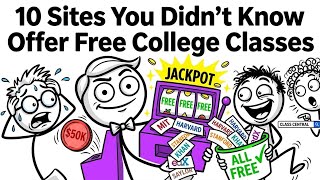
Short Summary
Main recommendation: Use free, legitimate online platforms such as OpenLearn, MIT OpenCourseWare, Saylor Academy, Khan Academy, edX, Stanford Online, Harvard Online, and Class Central to study university-level material at no cost. The video stresses that most of these resources give full course content, though some offer credit, certificates, or graded work only for a fee or under specific conditions. Coursera's free access has become more limited, so viewers should check whether a course is fully free before enrolling.
Key Points
- The promised list of 10 sites, as named in the video: (1) OpenLearn, (2) MIT OpenCourseWare, (3) Saylor Academy, (4) Khan Academy, (5) Coursera (audit reality, 2026 update), (6) edX, (7) Stanford Online, (8) Harvard Online, (9) Class Central, (10) the video's closing point on OpenLearn and open education as a whole.
- OpenLearn, run by the UK's Open University, offers over 900 free courses with lessons, quizzes, and a statement of participation, and downloadable PDF or EPUB versions.
- MIT OpenCourseWare publishes materials from actual MIT courses, including lecture notes, exams, and problem sets, with no sign-up required, and has been open since 2001.
- Saylor Academy's free courses prepare learners for CLEP and DSST exams, which can yield college credit for a $5 proctored exam fee.
- Coursera changed its audit mode in mid-2025 to "preview," which generally limits free access to the first module, though over 470 courses remain fully free.
Details Worth Noting
- Concrete instructions:
- To use OpenLearn: create a free account, enroll in a course, and download the material as PDF or EPUB to study offline.
- To use MIT OpenCourseWare: go to ocw.mit.edu, pick a course, and start learning; no sign-up or payment is needed.
- To earn Saylor-related credit: study a Saylor course that prepares for a CLEP or DSST exam, then take the proctored exam for about $5.
- To find Coursera courses that are fully free: check whether the course is fully free; if not, look for it on Class Central, and be prepared to pay if you want full access.
- To use edX: browse by level, subject, or university, and audit courses for free, paying only if you want the certificate or graded assignments.
- To use Class Central: search by subject, university, level, or language, filter for free courses, and read learner reviews.
- To use Khan Academy: watch short videos, practice, and move on at your own pace.
- Khan Academy covers more than math, including economics, finance, physics, biology, chemistry, history, and SAT, LSAT, and MCAT test prep, and is funded by donations; Sal Khan started it by tutoring his cousin online in 2008.
- edX's MicroMasters program offers graduate-level courses that can count toward a full master's degree at certain universities, with the option to pay for an exam to earn credit.
- Class Central indexes over 250,000 courses from thousands of universities and platforms, but it does not offer courses itself.
Bottom Line
The video presents a broad set of free, legitimate learning options, but viewers should verify free access on each platform, since certificates, graded work, and credit often require payment or specific exams.