 digest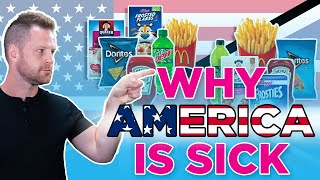
Short Summary
Main recommendation: Americans should recognize that many packaged foods sold in the U.S. contain additives banned or restricted in the UK and Europe, and should read labels carefully and choose simpler foods because U.S. regulation lets food companies largely police their own ingredients. The speaker argues that identical-brand products sold overseas often use cleaner ingredients, and that this difference is a major reason for poor health outcomes in America.
Key Points
- The speaker says the same brands (e.g., McDonald's fries, Quaker Oats, Mountain Dew, Heinz Ketchup, Doritos, Frosted Flakes) carry different ingredient labels in the UK versus the U.S.
- Examples of U.S.-only ingredients cited include Yellow No. 5 and Red No. 40 artificial dyes, brominated vegetable oil (BVO) in Mountain Dew, BHT preservative in Frosted Flakes, and high fructose corn syrup and GMO ingredients in Heinz Ketchup.
- The speaker contrasts Europe's precautionary principle (banning or labeling risky additives before proof of harm) with the U.S. approach (removing additives only after proven danger, a slow process).
- He claims that because companies choose cheaper ingredients for profit, consumers are effectively "lab rats" in the U.S. food system.
- The speaker says some reformulations happened after petitions (e.g., BHT removed from some Kellogg's cereals, BVO removal promised by Pepsi), yet certain products still keep the U.S. versions.
Details Worth Noting
- Concrete instructions: Read ingredient labels, especially for artificial dyes (Red No. 40, Yellow No. 5, Blue No. 1), BVO, BHT, and high fructose corn syrup, and compare them with the same brand's version sold in the UK or Europe where available. Check whether a packaged food contains real fruit or only flavored, colored fruit pieces, as in Quaker's instant oats. Prefer foods with natural colorants such as beta-carotene, paprika extract, and annatto, as the speaker describes. The speaker also says he has a free-book offer (you pay shipping) linked in the video, and that his Make Food Simple book has label-reading chapters, though these are promotions rather than instructions.
- The speaker states that some Doritos dyes are linked to benzidine and benzene contamination, and that the UK requires a warning label on certain dyes about activity and attention in children.
- The speaker presents these claims as his own research findings, drawing on a comparison resource from Food Babe and his own observations from the 2012 London Olympics; he explicitly states he does not advise eating any of these foods, healthy or not.
- The video was introduced as part of a series that includes a produce-section shopping tour, which the speaker says is linked elsewhere.
- He describes his background as an Olympic team doctor at the 2012 London Olympics, which is the basis for his firsthand observations.
Bottom Line
The speaker's core message is that regulatory differences, not just product design, explain why identical brands differ across borders, so U.S. consumers need to check labels closely rather than assume packaged foods are safe.


