digest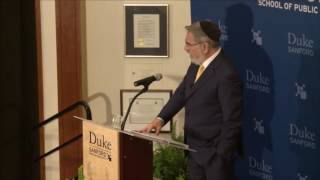
Short Summary
Main recommendation: Be politically correct in the sense of being polite and sensitive in language, but never ban or silence views; create safety by giving views you disagree with a respectful hearing. Rabbi Sacks argues that the "safe spaces" built by silencing opinions narrow discourse and harm universities, drawing on his own experience with his atheist supervisor, Sir Bernard Williams.
Key Points
- Rabbi Sacks grants that political correctness began as a good idea (being careful not to needlessly offend), but says it has gone too far by restricting what may be said, becoming an inhibition on free speech.
- His own experience: as a philosophy student under the atheist Sir Bernard Williams, he was taken seriously and challenged rationally, never ridiculed, which gave him the confidence to face hostile audiences later.
- He traces the tradition of defending free speech through a lineage (chronologically): the Islamic thinker Averroes, the rabbi Judah Loew of Prague, the Christian writer John Milton (Areopagitica), John Stuart Mill, and Sir Bernard Williams.
- He argues that restricting speech narrows discourse and will be a disaster for any university that adopts it.
Details Worth Noting
- Concrete instructions: Do not ban any views whatsoever; instead give views you disagree with a respectful hearing, challenge them on rational grounds rather than ridicule them, and always be polite and sensitive in how you address everyone.
- Rabbi Sacks trained as a philosopher at Cambridge and Oxford; after his undergraduate degree he went to seminary in Israel and came back very religious, 'much more religious than I am now'—a line he told with humor.
- Williams is described as the greatest atheist of his time and was known as the brightest man in England; the speaker notes not all atheists are intelligent.
- The speaker says the "safe space" was not one where his beliefs were silenced, but one where he was taken seriously and given room to articulate his view.
- The speech was delivered at Duke University's Sanford School of Public Policy.
Bottom Line
Safety on campus comes from respectful engagement with opposing views, not from restricting speech; politeness is compatible with open debate.