digest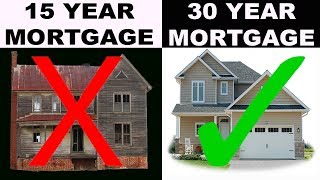
Short Summary
Main recommendation: Graham Stephan argues that a 30-year mortgage is often the better choice than a 15-year mortgage, mainly because the lower required payment frees up cash flow, increases borrowing capacity, and lets the borrower invest the difference. He acknowledges that the 30-year loan costs more interest on paper, but argues inflation and investment returns make it financially superior for most people who are disciplined. He also notes that the psychological value of being debt-free may outweigh the math for some people.
Key Points
- A 15-year loan has a lower rate (4.375% vs. 5% in his Chase example) and builds equity faster, but the higher monthly payment reduces cash flow and lowers how much a lender will qualify you to borrow.
- On a $300,000 loan, the 15-year payment is about $2,372 per month versus about $1,610 for the 30-year, a difference of $762 per month. Total interest is about $127,000 over 15 years versus about $279,000 over 30 years.
- Stephan argues the headline interest gap is overstated because future dollars are worth less due to inflation (about 2% annually), so later payments cost less in today's money.
- In his scenario comparison, investing the $762 monthly difference at a 7% after-inflation return (his stated S&P 500 historical average, not a guaranteed figure) leaves about $941,000 invested after 30 years versus about $732,000 in the 15-year scenario, roughly $200,000 more.
- A 30-year loan gives flexibility: you can pay it off early at any time and reduce required payments if income drops.
Details Worth Noting
- Concrete instructions:
- Check current mortgage rates from lenders such as Chase Bank, comparing the 15-year and 30-year rates.
- Calculate the monthly payment on the loan amount for both terms, and compare the difference in cash flow.
- If buying a home to live in, buy only at a price you could afford on a 15-year payment, but take the 30-year loan for flexibility.
- If the property is only affordable on the 30-year option, consider lowering your price range.
- For an investment property, take the longest-term loan available, since cash flow matters most and mortgage interest may be deductible.
- Invest the monthly payment difference rather than spending it, and do not choose the 30-year loan if you would spend the difference on non-investment items.
- Make extra principal payments on the 30-year loan voluntarily if you prefer to pay it off early.
- Stephan's tax example assumes a 22% tax bracket and itemized deductions, which reduce the effective interest rate (about 3.4% on the 15-year and about 3.9% on the 30-year before inflation).
- He explicitly says the math favors the 30-year loan only for disciplined borrowers and that debt-free peace of mind may be worth more to some people.
- He cites Dave Ramsey's advice favoring 15-year loans and states as his own opinion that "the shortest path to wealth is no debt, 100% of the time," while still preferring the 30-year loan mathematically.
- The 7% return, the 2% inflation rate, and the 5% and 4.375% rates are all his assumptions and examples, not guarantees.
Bottom Line
Stephan's conclusion is that a 30-year mortgage offers more cash flow, flexibility, and investment potential than a 15-year loan, provided the borrower invests the difference and avoids wasteful spending. Whether this suits you depends on your discipline and how much you value being debt-free.