digest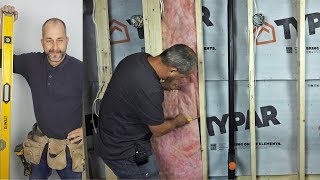
Short Summary
Main recommendation: To insulate a basement exterior wall without trapping moisture, staple Tyvek (a house wrap that diverts water) to the back of the 2x4 studs so an airspace stays between the insulation and the concrete, then fill the cavity with fiberglass batts and cover the wall with 6-mil poly as a vapor barrier. The video's goal is to keep the insulation dry and prevent condensation and musty smell.
Key Points
- The Tyvek layer guarantees an airspace between the insulation and the concrete, so if insulation falls out of the framework, it won't be in direct contact with the concrete, which helps prevent moisture buildup.
- Fiberglass batts are installed as a compression fit in 16-inch on-center framing, pressed into the cavity, and any gaps after installation should be filled in.
- The insulation must be carried all the way to the bottom plate, and the rim joist cavity above the concrete must be insulated too, so cold air and rodent-related drafts do not run down the wall.
- Use thermal insulation for exterior walls. Sound and fire insulation are different products and should not be substituted.
- Insulation should match the rest of the house: 2x4 upstairs means 2x4 with R12 in the basement, while 2x6 upstairs calls for a 2x6 wall with R20.
Details Worth Noting
- Concrete instructions:
- Measure the wall height and cut the Tyvek a little long. Have a helper hold the far end; roll the Tyvek up, feed it down behind the studs, and unroll it as you go.
- Pull the Tyvek over the last stud and around the front side, then staple it to the 2x4 so it sits on the back of the studs.
- Cut the batts at the bottom by inserting them, rolling forward, and measuring from there, or by pulling them out, marking, laying them against a stud, and cutting through. Insulate fully to the bottom plate.
- Around electrical boxes, measure and mark where the box comes through, cut the insulation to fit around it, and fill any gaps afterward so no cold-air holes remain.
- For the top rim joist area, either cut three pieces of insulation for the rim cavity and tuck them flush to the floor insulation, or insulate up the rim joists and across the concrete. Cut and tuck the corner behind the 2x4.
- After insulating, cover the wall with 6-mil poly. Cut it long, staple through a piece of cardboard at the seam so the plastic does not tear, and staple only at the top plate with a few staples. Pull it tight for drywall.
- Tape all seams and around boxes or wires, stretching the plastic as you go to avoid tears, so drywall does not bubble.
- The speaker says a moisture barrier is important in climates with varied temperatures, especially anywhere temperatures drop below minus 5°C, and recommends checking with your local building code officer if unsure.
- The presenter is in a cold Canadian climate and says the basement stays around 10 degrees year-round.
- Acoustic sealant is optional; it can be applied to the bottom and top plates to reduce air drafts, but is not required under the local code shown.
- The presenter speculates that a metal box lacking a vapor barrier behind it may have been an electrician's oversight, noting electricians aren't inspected on every job.
Bottom Line
Use Tyvek to hold an airspace behind the insulation, compress thermal batts tightly into the cavity, fully insulate to the bottom and up the rim joist, and finish with 6-mil poly where the climate calls for it, then verify with local code.