 digest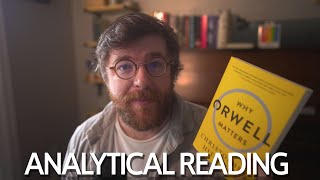
Short Summary
Main recommendation: Read hard books in stages, starting with a quick inspectional read to understand what the book is about before doing a slow, deep analytical read, following Mortimer Adler's framework from How to Read a Book. The video uses Christopher Hitchens's Why Orwell Matters as a running example and notes that synoptical reading (comparing multiple books on a subject) is the more advanced skill to develop later.
Key Points
- Most readers skip the step of figuring out what a book is about and start on page one; Adler's pre-read prevents that by first inspecting the book's blurb, table of contents, index (if present), and introduction.
- The inspection can reveal whether you are ready for the book, and suggest reading prerequisite material first (for example, Orwell's essays before Hitchens's book).
- The superficial read is a fast first pass with no stopping to look things up, with light pencil annotations.
- Analytical reading has six steps: classify the book, X-ray its structure, come to terms with the author's key terms, determine the author's message, criticize the book fairly, and decide your own conclusion.
- Structure determines how you read: an essay collection can be read selectively, while a multi-volume history like Kołakowski's Main Currents of Marxism likely needs to be read front to back.
- Synoptical reading means reading several books on one subject analytically and comparing their terms, arguments, and positions; the speaker says it is hard and takes years to develop.
Details Worth Noting
-
Concrete instructions:
- Before reading, inspect the book: read the back-cover blurb, scan the table of contents for topics, check the index if there is one for recurring topics, and read the introduction.
- Decide whether you are ready. If unfamiliar with the author's related work, read those first; if a particular interest exists, consider reading the most relevant chapter first to test it.
- Do a superficial read straight through without stopping to ponder or look up anything you don't understand, making light pencil annotations.
- For analytical reading, classify the book's genre and subject (for example, nonfiction, literary criticism, political writing about Orwell) so you know how to engage with it.
- X-ray the structure: note whether chapters are self-contained essays or build on one another, which determines whether you can skip around.
- Define the author's key terms (the speaker's examples include left and right in politics, feminism, postmodernism, and in general the terms a philosopher uses), and write a sentence or two on any central figure such as Orwell.
- Identify the author's specific positions and the reasons behind them, not just a general thesis.
- Criticize fairly: state the author's argument accurately, test whether it holds, and play devil's advocate by constructing counterarguments you may not yet find convincing.
- End with your own conclusion, which can be nuanced; disagreeing with an author is not disrespectful if you have engaged with the book in good faith.
-
The speaker notes that even people with advanced degrees struggle to get the most from what they read, so the framework is not only for beginners.
-
Synoptical reading is described as the advanced stage, and the speaker suggests focusing on analytical reading skills first.
Bottom Line
A hard book becomes manageable when you deliberately prepare for it, then read it twice: once quickly to orient yourself and once slowly to question and evaluate it.




