digest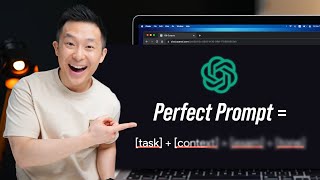
Short Summary
Main recommendation: Build every ChatGPT or Bard prompt from six components, in order of importance: task, context, exemplars, Persona, format, and tone. Only the task is mandatory, context and exemplars are important, and Persona, format, and tone are nice to have.
Key Points
- The six components are task, context, exemplars, Persona, format, and tone, and the speaker ranks them by importance, with task first and tone last.
- Context is the hardest part to get right; the speaker suggests asking three questions: what is the user's background, what does success look like, and what environment are they in?
- Exemplars (examples or frameworks) are not required for every prompt, but including a relevant one greatly improves output quality.
- A good Persona is someone you wish you had instant access to for the task, such as a physical therapist, recruiter, or senior product marketing manager; naming famous individuals works well when they're famous enough (e.g., Warren Buffett, Steve Jobs), and fictional characters like Batman also work.
- Specifying format (such as a table, bullets, or Markdown) makes the output directly usable, for example by pasting a table into a spreadsheet.
Details Worth Noting
- Concrete instructions:
- Start the task sentence with an action verb (generate, give, write, analyze) and state the end goal clearly.
- Ask yourself the three context questions (user background, definition of success, environment) and give just enough information to constrain the output.
- For resume bullets, use the structure "I accomplished X, as measured by Y, that resulted in Z."
- For interview answers, use the STAR framework: situation, task, action, results.
- To pick a Persona, think of someone you wish you had instant access to for the task.
- To choose a format, visualize the final result and specify it, such as a table with named headers or Markdown with H2 section headers.
- When proofreading with ChatGPT, instruct it to bold all changes so edits are easy to see.
- For tone, name the feeling you want (for example, "friendly yet confident") rather than trying to recall adjectives.
- The speaker's comprehensive example combines Persona (a senior product marketing manager at Apple who launched the Apple Car), context (an email to his boss, Tim Cook, about 12,000 pre-orders, 200% above target), task and format (a TL;DR, background, business results, and thanks), structure (clear and concise language), and tone (confident yet friendly).
- If you have an existing email or document, you can paste it and tell ChatGPT to follow the same format instead of describing the structure.
- The speaker says a prompt with the formula produces a much less generic, more usable result than a simple prompt for the same email.
Bottom Line
Prompt quality depends mainly on a clear task supported by just enough context, with examples, Persona, format, and tone added as needed.