 digest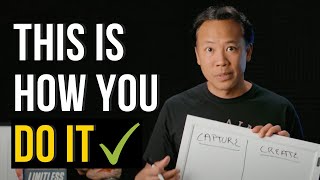
Short Summary
Main recommendation: Use the Capture-Create method for note-taking, dividing your page into a left side to capture key ideas and a right side to create your own connections, questions, and applications. Jim Kwik argues this turns passive note-taking into active learning that improves comprehension, retention, and implementation, and he presents it as a simple habit to practice daily.
Key Points
- Jim Kwik says research shows handwriting notes improves comprehension and retention compared with digital note-taking, though digital notes are more convenient for sharing.
- He cites research suggesting that about 80 percent of what is heard once is completely forgotten (the "forgetting curve"), so capturing notes is meant to counter that loss.
- Verbatim, word-for-word notes are described as one of the least effective methods, because key ideas matter more than complete transcripts.
- The right side of the page is framed as the place where imagination and creativity engage the "right brain" and help prevent mind-wandering during learning.
- Kwik adds that teaching someone else helps you learn the material more deeply, which he calls the "explanation effect."
Details Worth Noting
- Concrete instructions:
- Draw a single vertical line down the page to split it into two columns.
- Label the left column "Capture" and write key tips and ideas as you learn them. His examples include "no caffeine after 2 p.m.," using an alarm clock to also signal bedtime, keeping a consistent sleep schedule, using blackout curtains, and keeping the bedroom cool.
- Label the right column "Create" and write your impressions, such as "How can I use this?", how it compares to what you already know, questions you have, who you would teach it to, how it connects to other learning, and any contradictions.
- Ask yourself "Why must I use this?" during downtime to move the idea from head to heart.
- Ask "When will I use this?" and schedule implementation time, suggesting about one hour of application for every 15 minutes of listening.
- Practice the method today and repeat it daily to build the habit.
- Teach what you learned to a partner, team member, child, or family member.
- The method is presented as a self-help learning technique; the video makes no claims beyond its educational benefits.
Bottom Line
Note-taking becomes valuable when you both record ideas and actively develop them into applications, questions, and explanations, and the simplicity of the Capture-Create method is what makes it easy to start using immediately.




