digest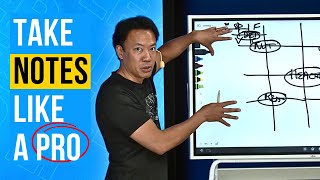
Short Summary
Main recommendation: Take notes using a four-quadrant mind-map method (Jim Kwik's version of mind mapping) that chunks information into groups of four, rather than writing verbatim transcripts. The method rests on a study he cites, done at Harvard by George Miller, suggesting people can consciously hold about five to nine pieces of information, so organizing ideas into four quadrants with subcategories keeps them within easy reach and shows how ideas connect. Jim Kwik says he uses this approach to write books and take notes.
Key Points
- Verbatim notes perform worse: Jim Kwik says that from his experience speaking at universities, people who take verbatim notes don't test as well as those who capture key ideas.
- Linear notes hide relationships: a 20-page document can bury an important point on page 17, whereas a single page lets you see how ideas connect.
- Chunking extends memory: grouping a 10- or 11-digit number into smaller chunks reduces it to about four pieces, making it easier to remember.
- The method works top-down: start with a broad topic, split it into four categories, then split each category into four more, repeating as needed.
- Books can be mapped the same way: seven habits or eight table-of-contents sections can be grouped into fours, even if they don't fit perfectly.
Details Worth Noting
- Concrete instructions:
- Take a blank sheet of paper and draw four quadrants.
- Write the topic (for example, "health" or a book title) as the starting point.
- Break the topic into four categories and write one in each quadrant. For health, the example categories were nutrition, exercise, rest, and environment.
- For any category that has more than four subparts, group related items so each quadrant holds about four. For example, under nutrition, diet is one branch; under diet, proteins, fats, fruits and vegetables, and carbs are four branches.
- Keep branching: under proteins, wild salmon is an example item; under supplements, split into vitamins, minerals, and herbs; under vitamins, vitamin D is an example.
- For a book with more than four items, combine related ones into the same bracket. For seven habits, pair two that belong together; for eight table-of-contents sections, put two in each quadrant.
- Add chapter subheadings beneath the map, even when they don't fit the 4x4 structure, because organizing them forces deeper understanding.
- Examples of other breakdowns given: exercise as aerobic, anaerobic, and yoga; environment as people and relationships, air quality, and water; rest as sleep, meditation, and bodywork.
Bottom Line
Rather than copying what you hear, condense it into a few chunked categories on one page, so you remember the key ideas and can see how they connect.