digest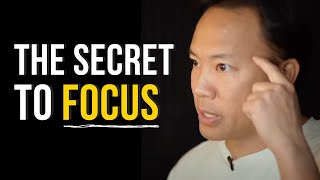
Short Summary
Main recommendation: Manage your focus by consciously choosing the questions you ask yourself, since questions act like a spotlight or magnet that pulls relevant information into your awareness through your reticular activating system (RAS). Jim Kwik calls this "lens management," and he argues that better questions produce better answers, actions, and results than repeating the same habitual thoughts.
Key Points
- The RAS filters incoming stimulus, and the brain is described as "primarily a deletion device," so attention is limited to roughly five to nine bits of information at a time.
- The average person has about 50,000 to 70,000 thoughts a day, and the speaker claims 95 percent of them repeat yesterday's thoughts, which keeps productivity and results stagnant.
- Questions pull information into the mind (like magnets), which the speaker contrasts with pushing information in, and he uses his "pug dog" experience to illustrate how focusing on a question makes related things suddenly visible.
- Asking "Who do I need to be at this moment?" instead of "What do I need to do?" shifts behavior, because the doing follows from the chosen identity.
- Innovation often comes from outsiders asking new questions, illustrated by Elon Musk questioning how a car would be built with today's technology.
Details Worth Noting
- Concrete instructions:
- Notice the questions you ask yourself regularly, and list your dominant questions.
- Ask whether each question makes you more productive, peaceful, and profitable, and whether it adds pleasure to your life.
- Replace unhelpful questions such as "Why am I not enough?", "How do I get people to like me?", or "Why can't I ever be productive?" with better ones.
- Use productive replacement questions, such as "What is the best use of this moment?", "Who do I need to be at this moment?", "How can I get the most done in the least amount of time and have fun in the process?", "How can I make this easier, more effortless, more lucrative, or more fun?", and "What am I grateful for today?"
- Before a decision or dilemma, ask "Who do I need to be at this moment?" to choose a quality such as bold, curious, playful, or compassionate.
- Use the 10-year-goal exercise: define a 10-year goal, then ask what it would take if you had only six months to achieve it.
- Shine your attention on areas you avoid, such as finances, your credit report, or a doctor's checkup, since the speaker says the treasure you seek is often hidden there.
- Take a small step by asking how to get a task done and enjoy the process, and apply the same approach with your team and kids.
- Set tighter time frames: the speaker notes that a task given 30 days will take 30 days, while three hours may be enough if you choose that deadline.
- The speaker recommends reading to succeed and cites The Structure of Scientific Revolutions, Zero to One by Peter Thiel, and Limitless (which he says Will Smith endorsed).
Bottom Line
Focus improves when you deliberately choose better questions, because your attention and actions follow the questions you repeatedly ask.