 digest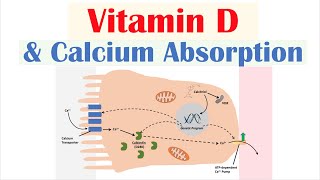
Short Summary
Main recommendation: Ensure adequate vitamin D intake, because vitamin D (in the form of cholecalciferol, or vitamin D3) must be converted into its active form, calcitriol, to enable proper calcium absorption in the small intestine. The video explains that this conversion requires functioning liver and kidney, and that calcitriol drives the cellular machinery that moves calcium into the bloodstream.
Key Points
- Vitamin D is obtained from food or produced in the skin as cholecalciferol (D3), which is not yet the active form needed for calcium absorption.
- Cholecalciferol is converted in the liver to calcidiol, which then travels to the kidney and is processed into calcitriol, the active form.
- Calcitriol binds to the vitamin D receptor in intestinal enterocytes and enters the nucleus to activate a genetic program.
- This program increases calcium transporters, calbindin-D (the cytosolic protein that shuttles calcium across the cell), and ATP-dependent calcium pumps, boosting calcium uptake into the bloodstream.
- The video notes this is why patients with renal failure are affected, since they may not produce enough calcitriol.
Details Worth Noting
- Concrete instructions: The video gives no step-by-step actions for the viewer to take; its concrete content is the National Institutes of Health recommended dietary allowances listed below.
- Vitamin D recommended dietary allowance (NIH, as cited): 400 international units per day for ages 0 to 12 months, 600 international units per day for ages 1 to 70 years, and 800 international units per day for those over 70.
- Calcium recommended dietary allowance (NIH, as cited): 200 mg/day (0 to 6 months), 260 mg/day (7 to 12 months), 700 mg/day (1 to 3 years), 1,000 mg/day (4 to 8 years), 1,300 mg/day (9 to 18 years), 1,000 mg/day (19 to 50 years), 1,000 mg/day for males and 1,200 mg/day for females (51 to 70 years), and about 1,200 mg/day over age 71.
- The mechanism is presented as a biochemistry lesson rather than personal health advice; the video does not provide dosing guidance for individuals.
Bottom Line
Vitamin D is a prerequisite for effective calcium absorption because it must be sequentially activated by the liver and kidney into calcitriol, which regulates the intestinal machinery that moves calcium into the blood.


