 digest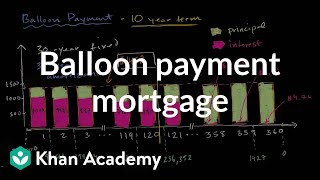
Short Summary
Main recommendation: A balloon payment mortgage can make sense only for borrowers who expect to sell, refinance, or come into cash before the loan term ends, because the remaining balance is due in one lump sum at that point. The loan keeps a standard amortization schedule (for example 30 years) while the actual term is shorter (for example 10 years), so payments look like a normal mortgage until the balance comes due.
Key Points
- A balloon loan separates the term (when the loan is due) from the amortization (how payments are calculated), so a 10-year term can still use 30-year payment math.
- Because the bank's interest rate risk is limited to the term, the lender may offer a slightly lower rate than a 30-year fixed mortgage with the same payments.
- The borrower carries the risk of owing a large remaining balance, which in the video's example is $236,352 after 10 years on a $300,000 loan.
- If the borrower cannot pay the balloon, the option is to take out a new loan, which depends on still having good credit and enough income at that time.
- This structure is less common than 30-year fixed, 15-year fixed, 10-year fixed, ARM, or hybrid ARM mortgages.
Details Worth Noting
- Concrete instructions: The video gives no step-by-step process for obtaining or managing a balloon loan. The actionable guidance it does give is to check whether the loan term and the amortization period differ, confirm the balloon amount due at the end of the term, and assess whether you can sell, pay off, or refinance the remaining balance when it comes due.
- The example uses a $300,000 loan with fixed monthly payments of $1,432.00 on a 30-year amortization. Under a 30-year fixed loan, the first payment is $1,000 interest, and the 358th payment is only $14 interest.
- For a 10-year term on the same 30-year amortization, the payments stay the same, but the remaining principal after 120 months is $236,352.
- Borrowers in this situation may plan to sell before the term ends, expect a future inheritance or income increase, or take out a new mortgage at the balloon date.
- The video compares this structure to adjustable-rate mortgages: in both, interest rate risk is shared differently between lender and borrower.
Bottom Line
A balloon loan lowers the lender's long-term risk and may lower the rate, but it shifts a large repayment onto the borrower at the end of the term. Its value depends entirely on the borrower's ability to pay off, refinance, or sell by then.


