digest
Short Summary
Main recommendation: The transcript does not recommend a product or action; its central answer to the Fermi Paradox is that we cannot yet know, and several plausible explanations (interstellar travel is hard, time is short, aliens may be too different or communicate differently, a hostile civilization may exist, or advanced civilizations may choose not to expand) remain open. It argues that humanity is only at an early stage of technological and historical development, so arrogant assumptions about alien life should be avoided.
Key Points
- Interstellar travel is extremely hard: materials must be assembled in orbit, a multi-thousand-year journey must be survived by a population large enough to restart civilization, and destination planets may be less hospitable than they look.
- Time scales may explain the silence: life has existed on Earth for about 3.6 billion years, intelligent humans for about 250,000 years, but long-distance communication technology for only about a century.
- Our communication methods may be primitive, so advanced aliens might not detect us, or might be too different from us to communicate meaningfully (compared to a squirrel trying to understand human society).
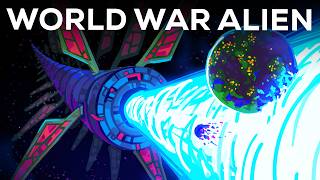
- Hostile or resource-driven civilizations could destroy other life, possibly using a self-replicating nano-machine probe that finds life, dismantles it, builds more probes, and repeats.
- Some argue advanced civilizations may have no reason to expand: the speed of light makes galactic travel slow, and a "Matrioshka Brain" around a star could host uploaded consciousnesses in a simulated universe.
- We do not know where the limits of technology lie, so future technology could be either close to its limits or far from them.
Details Worth Noting
- Concrete instructions: No concrete instructions, steps, or recommended actions for the viewer are given; the only "instructions" are the four hypothetical commands of a self-replicating probe (find a planet with life, disassemble everything on it into component parts, use the resources to build new probes, repeat).
- Stated figures: about 10,000 stars per grain of sand in the observable universe; possibly trillions of planets; a light-speed crossing of the Milky Way would take about 100,000 years; a red dwarf could power a Matrioshka Brain for up to ten trillion years.
- Historical framing: humans spent more than 90% of their existence as hunter-gatherers; about 99% of all Earth species have died out; 200 years ago human labor stopped being the main energy source; 30 years ago apocalyptic weapons were aimed at each other.
- The transcript describes a Type 3 civilization as one in need of resources that might evaporate oceans to gather materials.
Bottom Line
The Fermi Paradox has no settled answer; the silence may reflect distance, time, communication limits, hostile or indifferent aliens, or the simple fact that humanity is still early in its development and should stay humble about what it does not know.