 digest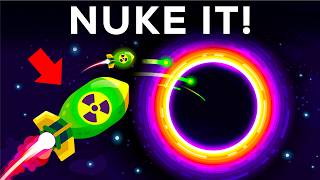
Short Summary
Main recommendation: Do not attempt to destroy a black hole by feeding it nukes, antimatter, an anti-black hole, or overspinning/overcharging it, since these either just make it more massive or risk exposing a naked singularity that could break physics; the only known safe method is to wait for Hawking radiation to evaporate it. The video concludes that a black hole can be destroyed only by waiting, which for a speck-of-dust mini black hole it would take about 10^44 years; the video does not give a figure for the Moon-mass black hole.
Key Points
- Throwing mass, energy, matter, or antimatter into a black hole only increases its mass, because black holes respond only to total mass-energy, not to whether the input is matter or antimatter.
- Black holes are described by just three numbers (mass, spin, and electric charge), so a black hole made from a star, anti-star, or banana is indistinguishable once formed.
- Colliding a black hole with an anti-black hole cancels the charge but produces a single, more massive, uncharged black hole.
- Destroying the event horizon would require overspinning or overcharging the black hole, but electrostatic repulsion and spin limits normally block further feeding, though some scientists have proposed a possible loophole to overfeed it just before the limit, a claim most scientists are skeptical of.
- If the event horizon were destroyed, the naked singularity could make space, time, and predictability break down, so the video argues nature likely prevents this.
Details Worth Noting
- Concrete instructions: The video gives no step-by-step procedure a viewer could follow. The only actionable method it describes is to wait for the black hole to evaporate through Hawking radiation, which slowly reduces its mass; for the speck-of-dust mini black hole this takes about 10^44 years.
- The singularity is not at the center of a black hole but lies in the future of anything that crosses the event horizon, since space and time swap roles there.
- Experiment numbering in the video: nuking (1), antimatter (2), anti-black hole (3), destroying the event horizon via spin/charge (4), and overfeeding (5), with the safe option at the end.
- The video says the time to evaporate depends on mass, giving about 10^44 years for the speck-of-dust example.
Bottom Line
Black holes cannot be destroyed by feeding or colliding them; the only known method is patience, as Hawking radiation slowly evaporates them over vast timescales.




