 digest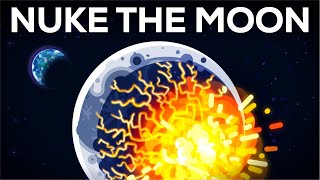
Short Summary
Main recommendation: Do not detonate a nuclear weapon on the Moon, because the explosion would not change the Moon's orbit but would create a lasting contaminated, hazardous environment for anyone there. The video models a 100-megaton thermonuclear warhead, roughly twice the power of the most powerful bomb ever detonated, and traces its effects step by step. The conclusion is that the Moon is not harmed in any meaningful orbital sense, but using it as a test ground ruins it for future exploration and construction.
Key Points
- Without an atmosphere, the Moon's explosion produces no burning, no shockwave, and no mushroom cloud; the fireball simply expands in silence and fades within seconds.
- X-rays from the fireball vaporize a thin cloud of surface rock, and dust inside the fireball melts into glass, so anyone within about 50 km would be fried.
- Ionizing radiation with no atmosphere to weaken it would be fatal to anyone close enough to see the blast well.
- The explosion would transfer roughly a tenth of its energy into seismic waves, producing a moonquake comparable to a magnitude 7 earthquake that could seriously damage or level infrastructure anywhere on the Moon.
- The Moon's orbit would be essentially unchanged; the blast would only leave one more crater among millions, since nuclear explosions, though big, are tiny compared to space.
Details Worth Noting
- Concrete instructions: No preparation, dosage, or step-by-step actions are given. The video's only actionable conclusion is negative: avoid detonating nuclear weapons on the Moon, since that would contaminate its surface and make it hazardous for later use.
- The blast would excavate roughly 100 million cubic meters of dust and rock, forming a crater about 1 km across, with debris flying off faster than escape velocity.
- Micrometeorites launched from the blast could spread across the lunar surface and rain down on Earth, though few would be larger than pebbles; satellites and stations in their path would be at serious risk.
- Radioactive fallout would remain on the surface, since there are no natural processes to wash it away or bury it; radiation would fall to natural cosmic-ray levels in about a year.
- The fireball would briefly be visible from Earth as a flickering star that quickly fades.
Bottom Line
A nuclear blast on the Moon would be eerily silent and violent but would not move the Moon, and its lasting radioactive contamination is the real harm.




