 digest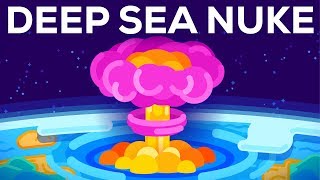
Short Summary
Main recommendation: No, detonating humanity's most powerful nuclear bomb in the Mariana Trench would not trigger tsunamis, earthquakes, volcanoes, or any change to Earth's orbit; the effects would be localized and minor. The video models a 50-megaton blast (the RDS-220 "Tsar Bomba") at Earth's deepest known point, about 11 km down, where extreme water pressure limits the fireball's expansion.
Key Points
- The deep-ocean pressure, roughly a thousand atmospheres, makes the fireball shrink and collapse within about a second, rather than expanding as it would in air.
- The collapsed bubble breaks into smaller hot, radioactive bubbles that rise to the surface, producing only a small wave and a plume of warm, radioactive water.
- Radioactive fallout would dilute into the Pacific within a few days, with some water and salt reaching the atmosphere and falling back as rain, mostly over the ocean.
- Explosion-triggered earthquakes are judged unlikely: most energy goes into the water, and natural quakes of similar seismic energy occur a few times a year.
- The bomb's mass is negligible relative to Earth, and over a thousand past nuclear tests have not measurably altered Earth's orbit.
Details Worth Noting
- Concrete instructions: No preparation, dosage, or step-by-step actions were given; the content is a hypothetical physics scenario, so no actionable advice was offered.
- Tsar Bomba's shockwave reportedly circled the Earth three times, and its mushroom cloud stretched 56 km into the sky, which provides the contrast for the trench scenario.
- The Mariana Trench sits at the edge of two tectonic plates and is about three times deeper than the Titanic's wreck site.
- Local effects would still matter: boats and whales in the immediate area could be harmed, and the video notes the worst fallout would likely fall over the oceans, not populated coasts.
- The video's conclusion is framed as scientific reasoning about a hypothetical, not an assessment of nuclear policy or safety guidance.
Bottom Line
A deep-ocean nuclear blast would be far less catastrophic than commonly imagined, because the trench's crushing pressure contains the explosion and the effects stay mostly local.


