 digest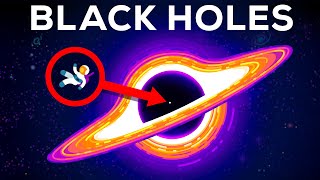
Short Summary
Main recommendation: Treat black holes as extreme, counterintuitive objects where, as far as current physics can tell, what falls in cannot be recovered, and where the only sensible action is to avoid getting close. The video explains how black holes form and are observed, what a traveler would experience near and inside one, and how they may eventually evaporate, while noting that the singularity at the center is not described by current theory.
Key Points
- Black holes form when very massive stars die; their insides implode at nearly a quarter the speed of light, packing so much mass into so little space that they break the stage of the universe.
- The event horizon is a one-way boundary: because nothing, not even light, can escape, black holes cannot be seen directly and are detected mainly through matter orbiting them.
- Near a black hole, gravity can bend light into orbit, so an observer at the photon sphere would see the back of their own head.
- Gravity slows time, so distant observers would see a falling traveler in slow motion, while the traveler could see the rest of the universe speed up.
- Smaller black holes can cause "spaghettification," where tidal forces stretch a body apart before it crosses the horizon; supermassive ones are less violent at the horizon.
- Real black holes are likely spinning, which creates an ergosphere where staying still is impossible, and they may eventually shrink and evaporate via Hawking radiation.
Details Worth Noting
- Concrete instructions: The video gives no instructions for dealing with black holes. Its only practical guidance is that once inside the event horizon, moving in any direction only brings you closer to the center faster, so "to survive the longest, you must do nothing." It also notes that inside a spinning black hole's ergosphere you cannot stay still and will be pulled into orbit regardless of effort.
- A 10-solar-mass black hole would be only about 60 kilometers across.
- Matter in orbit near a black hole can reach about half the speed of light and heat to around a billion degrees, making the surrounding space very bright.
- A black hole with the Sun's mass would take about 10^67 years to evaporate; the most massive supermassive black holes could take about 10^100 years.
- Black holes are described as having only three properties (mass, spin, and electric charge); the video says singularities would be identical like fundamental particles, though mass and spin differ between black holes.
- The singularity is where general relativity breaks down, so the video notes it may not exist or may be entirely different from what current theory predicts.
Bottom Line
Black holes are real, observable through their effects, and fundamentally mysterious at their cores; the video's own point is that the physics we have is incomplete, so their interiors remain an open question.




