 digest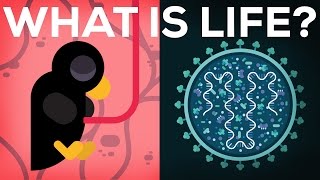
Short Summary
Main recommendation: Think of life not as a special substance but as an organized process that resists decay, and accept that the boundary between living and non-living is blurrier than it seems. The video argues that no single cell part is alive on its own, that viruses and mitochondria complicate the definition, and that the answer may hinge on information persisting through time. It ends by asking whether life and death are meaningful distinctions at all.
Key Points
- Physicist Erwin Schrödinger defined life as something that avoids decay into disorder and equilibrium, illustrated with a messy download folder that must be cleaned up with energy.
- Every living thing is made of cells, which share traits usually assigned to life: a boundary wall, self-regulation, feeding, growth, reaction to the environment, evolution, and reproduction.
- No individual part of a cell is alive; cells are chemical reactions among dead matter, with several million reactions per second.
- Viruses (RNA or DNA in a shell that needs cells to act) and mitochondria (once free-living bacteria, now dependent and arguably dead) blur the living/non-living line.
- The video suggests life may be information that persists, and that AI and computer viruses could challenge our definitions further.
Details Worth Noting
- Concrete instructions: No step-by-step actions, preparation, or practical instructions are given; the video is explanatory and ends with questions for the viewer to consider.
- The video states there are about 225,000,000 m³ of viruses on Earth, and mentions viruses that invade dead cells and reanimate them to serve as hosts.
- Mitochondria "traded their own life for the survival of their DNA," which the video uses to argue living things can evolve into dead things as long as it's beneficial to their genetic code.
- The video says a cell can build several thousand types of protein, and compares its constant self-rebuilding to driving a car at 100 km/h while replacing every part.
- It credits Charles Darwin with shifting the human view of being separate from other living things, and warns that advancing AI may again threaten that self-image.
Bottom Line
Life may be better understood as a persistent, self-maintaining pattern of information and chemistry than as a distinct substance, so the question of what counts as alive remains open.




