 digest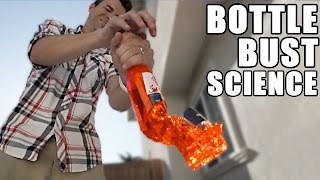
Short Summary
Main recommendation: To break a bottle with a bare-hand strike, hit the bottle itself rather than your hand, and use water or another non-carbonated liquid instead of beer or sparkling water. The video's experiments found that a sharp downward hit creates a low-pressure vacuum at the bottom of the bottle, and the rebounding water then cracks the base, with the break happening when the water returns to fill that vacuum.
Key Points
- The pressure wave theory (that slamming the hand forces air in and pushes out the bottom) was rejected, because a capped bottle—so no air could be forced in—still broke when struck with a rubber mallet.
- Carbonation works against the break: when the bottle is struck, CO2 from carbonated liquid fills the vacuum with gas bubbles that rise through the liquid, cushioning the rebound force.
- Non-carbonated liquid lets the vacuum form cleanly, so the bottle breaks more reliably when water is used.
- The break happens as the water rebounds: the water cavity collapses 10 times faster than it formed, producing a force greater than the initial hit, and the bottle cracks right after the water hits the bottom.
Details Worth Noting
- Concrete instructions: Strike the bottle, not your hand, so as much energy as possible goes into moving the bottle. Optionally, wet the neck slightly so it slips a bit on impact, ensuring the bottle moves.
- Concrete instructions: Use water or another non-carbonated liquid, since carbonation fills the vacuum and cushions the rebound.
- Concrete instructions: Choose a liquid with a high vapor pressure, because it forms the needed bottom vacuum more easily. Hot water works better than cold water for this reason, and nail polish remover also works well.
- Concrete instructions: Be careful about where the glass lands, since it can cut you.
- Concrete instructions: Follow through on the strike; hesitating makes it hurt more.
- The experiments were filmed at about 7,000 frames per second, which showed the crack forming right after the water hits the bottom.
Bottom Line The break is caused by the rebound of liquid into a low-pressure gap, not by air forced into the bottle, so a fast, committed strike on a non-carbonated, high-vapor-pressure liquid gives the best result.




