digest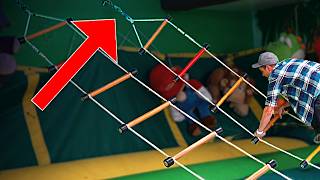
Short Summary
Main recommendation: Avoid the carnival games that are designed to be near-impossible or heavily stacked against you, and only play the skill-based games if you have real practice in them. The video argues carnival games are engineered with subtle physical tricks that make winning far less likely than it looks, and that even winners often lose money on the prize's real cost. It also identifies the rare games where skill can actually beat the odds.
Key Points
- Random chance games (like the ping pong toss) use lightweight, high-bounce balls, so an imperfect throw is magnified and results are essentially random: about a 10% win rate in the observed cup game, and expected cost around $7.50 to win a 45-cent prize (on average 5 throws needed for a 1-in-5 chance per throw).
- Skill games are tilted in subtle ways: the basketball hoop is 28 feet back at 11 feet high instead of the standard 24 feet and 10 feet, and the table is slanted to reduce the ball's horizontal speed after the bounce.
- The radar gun in the pitch speed game reads about 15 mph too slow; a 69 mph reading was measured closer to 84 mph by high-speed frame counting.
- Near-impossible games, such as the BB gun star, spring bottle ring toss, and ladder climb, produced zero wins across hundreds of plays, with the ring game having a bottle-to-ring fit so tight that none of 840 rings stayed on.
- The ladder climb is the only game that is almost purely skill: its support narrows to a single contact point, so you must keep your center of mass over a line, like walking a tightrope, which takes real practice.
Details Worth Noting
- Concrete instructions:
- Milk bottle game: ask to hold the bottle and find its balance point on your finger; if it is bottom-weighted it is steadier. Aim for the middle of the bottle with a firm but not maximum-force throw, since the hardest throws sacrificed accuracy; about one in 14 people knocked it over on the first try.
- Basket toss game: aim so your first bounce hits the front lip of the basket, which drains enough energy that the ball won't bounce back out; about one in 10 throws won on observation.
- Ladder climb: keep your center of mass directly above the single support line, make small body adjustments, and expect to need substantial practice; the video notes that tips such as keeping three points of contact are largely useless.
- Basketball toss: a player used to a standard three-pointer will tend to miss short on this slanted, longer-distance setup, so adjust for more distance and the table slope.
- Expected-value math used in the video: a yellow cup prize at about one in five throws costs roughly $7.50 for a $0.45 item; the gold cup at about one in 25 throws costs about $38 for a roughly $6 prize.
- The video says roughly $20,000 per day was collected from the 24 carnival games at the park studied.
- Carnival owners profit most where customers overestimate their chances, and the video advises avoiding booths with very large prizes if you want the feeling of winning.
- The video's closing advice: play for fun if you enjoy it, but if your goal is winning a stuffed animal to impress someone, buying one on Amazon works just as well.
Bottom Line
Carnival games are built to look winnable while the physics, prize costs, and rigged setups keep most players losing, so budget for entertainment rather than expecting a profitable win.