 digest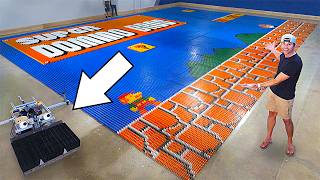
Short Summary
Main recommendation: Mark Rober's robot "Dom" (formally "The Dominator") is built for one purpose: setting up dominoes far faster than any human, which it proved by beating Lily Hevesh in a head-to-head test and setting a Guinness World Record by laying just over 102,000 dominoes in just over 24 hours. The video shows how the system was engineered to handle scale and reliability, a challenge Rober estimated would take a team of seven skilled builders one full week.
Key Points
- The core breakthrough was laying 300 dominoes at once: 3D-printed funnels and a "Connect Four" style sliding tray drop a full tile of dominoes simultaneously, instead of placing them one by one.
- In the speed round, Dom placed 9,001 dominoes in a little over two hours, while Lily Hevesh, known as the "Domino Queen," was insanely fast but could not match the robot's sustained pace.
- The robot's loading chutes, made from 2.7 miles of Hot Wheels track, let Dom load without waiting on the robotic arm each time, since 300 dominoes load at once.
- Dom navigates using pre-programmed routes, indoor GPS sensors for rough position, and IR cameras tracking ground markers for precise placement.
- The build reportedly took five years and involved a software engineer and two Stanford freshmen, with Dom's control code totaling over 14,000 lines written from scratch.
Details Worth Noting
- Concrete instructions: The video gives no step-by-step guide a viewer could replicate, but it describes the method used: pre-program the full placement route before running, drop 300 dominoes per tile using funnels and a sliding tray, lower the platform onto the floor to set dominoes gently, and use omni wheels with brushless servo motors for millimeter-level corrections.
- The omni wheels allow movement in any direction, avoiding the multi-point turns a car would need for small position adjustments.
- Dom was able to work overnight in the dark, which Rober presented as a key goal: set it up, turn off the lights, and return to a full field of dominoes.
- Rober notes that Dom finished in just over 24 hours and was about 50 times faster than a skilled domino builder, placing the record in the "non-human category."
- The final knockdown used Mario-themed pipes as triggers, with a motorized cart pulling a shell along Hot Wheels tracks to tip the levers.
Bottom Line
The video's real takeaway is that the robot's success came from solving scale and reliability problems through precise engineering: batch placement, automated reloading, and accurate navigation, rather than from speed alone.


