digest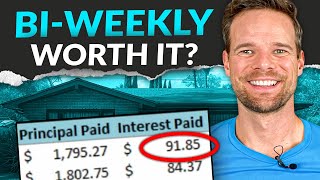
Short Summary
Main recommendation: Switching from monthly to biweekly mortgage payments can help you pay off your mortgage faster and save interest, because 26 half-payments (one every two weeks) add up to one extra full monthly payment per year compared to paying monthly. The speaker stresses that this only works if your lender allows biweekly payments and any enrollment fees don't outweigh the savings.
Key Points
- Your mortgage payment is split into principal (the money borrowed) and interest (the lender's charge), and interest is front-loaded early in the loan.
- An amortization schedule, a table showing each payment's split between principal and interest over the loan's life, shows how the balance shrinks over time.
- Biweekly payments add up to one extra full monthly payment per year without much change to your budget.
- Biweekly payments do not raise your credit score, because credit bureaus review data on a monthly time frame.
- Other options include making extra principal payments, refinancing to a lower interest rate, or a mortgage recast to lower monthly payments.
Details Worth Noting
- Concrete instructions: Confirm with your lender that biweekly payments are allowed, and ask whether you must opt in and whether there is a fee. Crunch the numbers before enrolling to confirm you come out ahead. If fees are high, check whether you can make extra payments directly toward principal instead. To test the impact, use a mortgage amortization calculator (the speaker suggests searching "mortgage amortization calculator" or using the calculator in the blog post linked in the description), enter your loan amount, term, and rate, and compare the schedule with and without extra payments.
- Worked example from the video: at $2,000 per month, monthly payments total $24,000 per year, while $1,000 every two weeks totals $26,000 per year, leaving the principal about $2,000 lower at the start of the next year.
- The speaker's own example used a $195,000 original loan, a 15-year term, and a 3% rate, with an average of $3,000 per month in extra principal payments, and says that the extra payments shortened the schedule dramatically (to about 48 months, versus 180 months with no extra payments).
- Escrow: if taxes and insurance are bundled into your payment, the lender sets aside funds and pays those bills on your behalf.
Bottom Line
Biweekly payments are a low-effort way to add one extra payment per year, but their benefit depends on lender policy and fees, so compare them against direct extra principal payments before choosing.