digest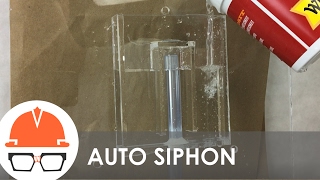
Short Summary
Main recommendation: The video explains the bell siphon, a self-priming siphon that starts and stops automatically without a pump, valve, or manual priming. It works by using the water level and air pressure inside a bell-shaped chamber to repeatedly create a vacuum that draws water out of a reservoir and then resets.
Key Points
- A regular siphon relies on atmospheric pressure pushing water over a high point, but it must be manually primed, typically with a valve and a port, or by mouth for small tubes.
- A bell siphon has three parts: a reservoir, a bell (an inverted chamber), and a riser tube, and it primes itself without intervention.
- As water rises inside the bell, it seals the riser tube, and water falling down the riser creates a vacuum that pulls more water out of the reservoir.
- When the reservoir drops below the bell, air enters and breaks the siphon; the remaining water drains and the cycle restarts.
- Real-world uses include septic leach-field dosing, hydroponics and aquaponics wet-dry cycles, and automatic urinal flushing in public restrooms.
Details Worth Noting
- Concrete instructions: The video does not give step-by-step build instructions. The actionable takeaway is the design principle: build a reservoir, a bell that seals over the riser tube as the water rises, and a riser pipe open to air, so the water level naturally cycles the siphon on and off.
- The demonstration bell was built from an acrylic sheet and a piece of clear pipe, made for a water science display at the American Geophysical Union fall meeting in San Francisco.
- The Pythagoras cup is the same mechanism and is one of the oldest practical joke devices.
- Using your mouth to start a siphon is dangerous with fuels or toxic liquids, as people have ingested gasoline doing so.
- Big Clive's teardown of a multi-stage bell siphon for urinal flushing is referenced, showing these systems can be more complex than they appear.
Bottom Line
A bell siphon is a self-starting, self-resetting siphon that removes the need for manual priming by letting water level and air pressure drive a repeating cycle.