digest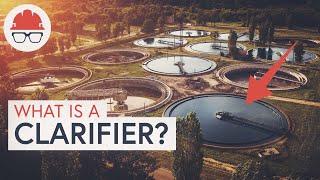
Short Summary
Main recommendation: The video explains how gravity-driven sedimentation, slowing the flow in large basins so suspended solids settle out, is used as a key early step in cleaning sewage and drinking water. The video explains that settling basin size depends on the surface loading rate, not depth, and that chemical coagulation and flocculation are added when particles are too fine to settle on their own.
Key Points
- Primary treatment at a plant like Stickney in Chicago uses screens to remove sticks and rags, then sedimentation basins to let suspended solids settle.
- Slowing flow works because increasing cross-sectional area lowers velocity; basins act like enormous expansion fittings on the pipe.
- Settling speed depends mainly on particle size: larger particles reach terminal velocity and fall faster than fine ones, as shown in the sand demonstration.
- Basin efficiency is measured by the surface loading rate (flow rate divided by surface area), and particles settling faster than this rate are retained regardless of basin depth.
- Fine particles such as clay-like soil stay suspended because they carry electrical charges; coagulants neutralize these charges and flocculants bind them into heavier flocks that settle.
Details Worth Noting
- Concrete instructions: The video explains the engineering principle that sedimentation basins are sized using the surface loading rate (flow divided by basin surface area), so that target particles settle regardless of basin depth, and that treatment plants add coagulants and flocculants to help fine particles settle, usually in two steps.
- The Stickney plant handles about 700 million gallons (2.5 billion liters) of sewage daily and can process nearly double on peak days, serving over two million people.
- Clarifiers are circular settling basins with mechanical scrapers that push sludge into a hopper; clarified water exits over a weir from the top layer.
- Sedimentation is also used ahead of pumping stations to protect pumps and pipes, in canals to prevent silting, in fish hatcheries, mining, and farming.
- The demonstrations (sand fractions separating by size, and a bottle of dirty water with coagulant) illustrate the physics but are simplified compared with real plant conditions.
Bottom Line
Gravity-based settling, sized by surface area and aided by chemicals for fine particles, is a cheap, foundational step that removes most contaminants before filtration and disinfection.