 digest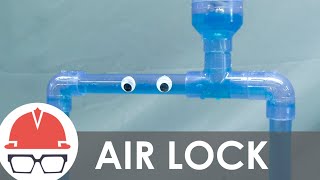
Short Summary
Main recommendation: Engineers should account for trapped air (air lock) in pipelines by designing for it, since gas can enter pipes through dissolved gas, leaks, or simply being present when a pipe is first filled, and it lodges at high points where it constricts flow. The video frames air lock as a common, well-known engineering problem with three practical fixes: stronger pumps, pipe layouts that avoid trapping air, or automatic air release valves.
Key Points
- Air lock is a constriction in flow caused by a gas bubble trapped in a pipe; the video says it is effectively a constriction like a kink in a hose.
- Gas enters liquid pipelines through dissolved gas that comes out of solution when warmed, agitated, or chemically reacted, and through leaks at joints where pressure is below ambient.
- Gas is trapped because it is much less dense than liquid, so it floats and collects at any high spot in the pipe.
- Trapped air takes up cross-sectional area without contributing to flow, forcing engineers to account for it when sizing pipes.
- As a bubble grows, the hydraulic grade line drops by the height of the resulting "waterfall" flow; if it drops below the pipe outlet, flow stops entirely, which is called air lock or vapor lock.
Details Worth Noting
- Concrete instructions: The video gives no step-by-step build or maintenance procedure for homeowners. Its actionable guidance for engineers is to (1) size the pump to overcome air lock losses, but note this becomes impractical on long pipelines with many undulations because pipe pressure rating near the pump would need to be enormous; (2) design routes that avoid high spots, or where undulations are unavoidable, install automatic air release valves at high points; (3) when a bubble grows large enough, a float-operated valve pulls open to vent the air, and the speaker suggests spotting these valves on existing infrastructure.
- Irrigation lines on farms sit on the surface because they must be moved, so they follow terrain and naturally collect air at hilltops and embankments.
- Water and petroleum pipelines can be buried, but digging deeper raises cost, so routing often follows a hill up and down rather than going straight through.
- Building fresh-water and heating lines must route around obstacles, creating high spots that can trap bubbles.
- Cities use automatic air release valves rather than sending technicians to bleed lines daily; the speaker built a demo with a float glued to a check valve that stays closed when there is no air.
- The hydraulic grade line is a graphical tool showing the energy available in the fluid along the pipe; it slopes down from friction and drops steeply at bends and valves.
Bottom Line
Air lock is a predictable, well-understood hazard, so good pipeline design anticipates trapped gas rather than assuming it away.



