 digest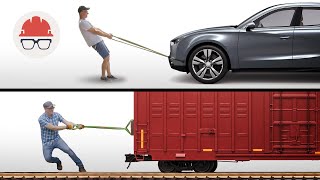
Short Summary
Main recommendation: Railways are engineered to minimize energy use, so route choice should avoid steep grades and tight curves, and rolling resistance (friction, deformation, and air drag) should be kept as low as possible, since steel-wheel-on-steel-rail travel is far more efficient than trucks for heavy loads moving long distances. The video uses hypothetical gravel-hauling comparisons and a real rail car test at the Texas Transportation Museum to illustrate how these resistances add up.
Key Points
- Moving 25,000 tons of gravel would take roughly 625 semi-trucks versus a handful of diesel locomotives, illustrating the energy gap.
- Grade resistance is the biggest obstacle: a common rule of thumb is about 20 lb (9 kg) of tractive effort per ton of train weight per percent of grade, so railways keep grades gentle, often under half a percent.
- Curves add drag: a 1-degree curve adds about 1 lb per ton of train weight, a 5-degree curve roughly quadruples that, and a 10-degree curve doubles it again.
- Rolling resistance on a level track comes from steel contact deformation, bearing friction, and track/wheel imperfections, and it can be very low on rail compared with rubber tires on roads.
- The Davis Formula, originally published in 1926 and modified in the 1970s after roller bearings became standard, splits train resistance into three parts: weight-dependent mechanical resistance, speed-dependent resistance from truck sway and jostling, and air resistance that scales with speed squared.
Details Worth Noting
- Concrete instructions: The video gives no step-by-step procedure for a viewer to follow. The actionable guidance is for route and design choices: avoid direct routes over steep terrain, prefer gentle grades (often under half a percent), limit curvature (1 to 5 degrees for high speeds; practical slow-speed limits around 12 degrees), and consider bridges or tunnels when going around an obstacle costs more than building through it. Use distributed power (locomotives placed in the middle of long trains) to divide in-train forces. Keep brakes fully disengaged when moving a rail car, since residual brake drag greatly increases rolling resistance.
- A wheelchair ramp at the US maximum of 8.3 percent grade would require over 5 million lb (2 million kg) of pull for the gravel train, far beyond a drawbar's capacity.
- On descents, trains with steep grades must use brakes, so energy gained climbing is wasted as heat.
- Rolling resistance test: the presenter's car needed about 30 lb (14 kg) to roll, and about 60 lb on gravel; the 20-ton flat car needed about 50 lb (32 kg) of force after subtracting grade from the measured ~150 lb pull (with ~100 lb due to grade alone), similar to the car on gravel despite weighing 15 times as much.
- Rail joints and small track imperfections can double or triple the force needed, even briefly.
- The video notes that railways rarely use the straightest route when it crosses steep terrain, and that the winding path can be as expensive as climbing over the mountain.
Bottom Line
Efficient railway design is largely a battle against resistance: gentle grades, gentle curves, and smooth steel-on-steel contact are what let a few locomotives haul loads that would otherwise need hundreds of trucks.


