 digest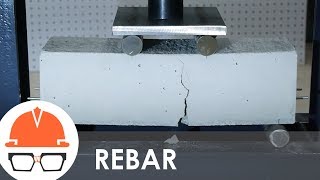
Short Summary
Main recommendation: Reinforce concrete with steel, usually deformed steel rebar, because concrete is strong in compression but weak in tension, and reinforcement adds tensile strength while changing failure from sudden brittle breakage to a more gradual ductile failure. The video uses simple home demonstrations with cast cylinders and beams to show this, and it also introduces prestressed concrete as an option when cracking must be avoided.
Key Points
- Concrete handles compression well but has very low tensile strength; in the demo, a compression test failed near 1,000 lb (450 kg), while a tension test on a sample failed at about 80 lb (36 kg) of load, under 10% of its compressive strength.
- Most structural members experience mixed stresses, such as a beam with compression on top and tension on the bottom, so plain concrete is not a good structural material on its own.
- Steel reinforcement changes the failure mode from brittle (no warning) to ductile (visible cracks form before total loss of strength), giving a chance to spot and address problems.
- Passive rebar only resists tension after the steel stretches, which usually means the concrete must crack first; this is acceptable in many cases but not where cracks or excessive deflection must be avoided.
- Prestressed (active) reinforcement applies stress before service; pretensioning tensions tendons during casting, while post-tensioning tensions rods after curing. The post-tensioned demo beam resisted more load before cracking, though it failed at the nut threads.
Details Worth Noting
- Concrete instructions: No step-by-step construction procedure is given. The actionable guidance is: do not make structural members from plain concrete where tension occurs; add reinforcement, most commonly deformed steel rebar, to provide tensile strength; if cracking or excessive deflection must be avoided, consider prestressed concrete, either pretensioned (tension the steel during casting, so the tension remains after curing and compresses the concrete through friction) or post-tensioned (cast plastic sleeves, let the concrete cure, then tighten nuts on steel rods to tension them).
- The demonstration beam with two steel threaded rods in the lower portion failed later and more visibly than the unreinforced beam, with cracks forming and propagating before failure.
- In the demo, the post-tensioned beam did not outperform the conventionally reinforced beam in ultimate strength, but it resisted more pressure before cracks formed; its failure began at the nut threads rather than the rods.
- Rebar is described as relatively cheap, well-tested, and well understood, which is why it is the common choice for most reinforcement situations.
- The presenter notes this is only an introductory overview of a complex topic, and that engineers often spend entire careers designing reinforced concrete structures.
Bottom Line
Plain concrete is strong in compression but fails easily in tension, so practical structures depend on steel reinforcement, with prestressing used where cracking must be controlled.

