 digest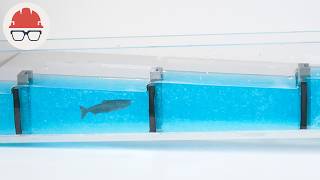
Short Summary
Main recommendation: The video explains that fish ladders are designed as species-specific, hydraulically tuned passages that mimic natural river conditions, with pool-and-weir, Ice Harbor, and vertical slot among the main designs discussed. The video explains that engineers balance water flow, attraction flow, and elevation breakdown to get migratory fish, especially salmonids, over dams. Success rates vary widely by species and dam, and are measured mainly through fish tagging and counting stations.
Key Points
- Dams benefit people through hydropower, flood control, irrigation, and water supply, but fragment habitat for migratory fish, especially salmon.
- Fish ladder design is treated like life-support engineering, driven by biological criteria: swim speed and endurance, motivation, jump height, and tolerance for temperature, oxygen, pH, and salinity.
- Attraction flow is essential because the ladder entrance rarely spans the full dam width; salmon use sound and turbulence to find the entrance, so McNary uses pumps and a valve-conduit system to create it.
- Pool and weir fishways are the oldest design but are less effective because they can exclude weaker or less capable species; the Ice Harbor design, which McNary uses, adds submerged orifices and better flow variety.
- Vertical slot fishways keep flow consistent across changing reservoir levels, unlike weir and orifice designs that are sensitive to forebay water levels.
- One study found 97% of Chinook, Sockeye, and steelhead entering a dam tailrace made it up the ladder, but results vary widely for other species and dams, and measuring effectiveness is complicated.
Details Worth Noting
- Concrete instructions: The video gives no step-by-step build procedure, but its design guidance is actionable: keep the ladder slope in the roughly 10 to 15 percent range, breaking total dam height into passable baffled increments; set flow high enough to attract fish but low enough to swim against; provide auxiliary water systems so attraction flow does not depend only on ladder flow; use a trash rack at the upstream exit to keep debris from clogging baffles; and, where feasible, use crest gates or vertical slot baffles to handle changing forebay levels.
- Steeper channels are shorter but create faster flow; shallower channels are gentler but longer and costlier, so the 10 to 15 percent slope is a compromise.
- The NOAA Fisheries Anadromous Salmonid Design Manual is cited as a detailed reference for salmon fishway design.
- Counting stations use a viewing window and sloped pickets that funnel fish past observers, though pickets can discourage some fish from continuing upstream.
- Alternatives to ladders include fish elevators, barging fish past dams, the Whooshh fish cannon, and dropping fish from airplanes, which the video says did not work well.
Bottom Line
Effective fish passage depends on tailoring each fishway to its target species and site conditions, because no single design or success rate applies everywhere.


