 digest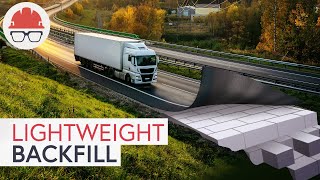
Short Summary
Main recommendation: To reduce the "bump" at bridge approaches caused by embankments settling on soft soil, use lightweight fill materials instead of heavy soil, which cuts the load on the foundation and shortens or eliminates long settlement waits. The video covers several options, including wood fiber, shredded tires, expanded shale and clay aggregate, foamed glass aggregate, cellular concrete, and expanded polystyrene foam (EPS, or geofoam).
Key Points
- Bridge-approach bumps happen because a bridge sits on rigid deep foundations while the adjacent embankment is a heavy soil pile that settles on soft ground.
- In his hypothetical example of a transportation engineer's project, limiting settlement to 2 inches (5 cm) could require about 3 years of waiting before paving, illustrating why speeding up the process matters.
- Most of the load on the ground comes from the embankment itself, not traffic, so replacing soil with lighter material cuts foundation loading.
- Lightweight fill also reduces lateral earth pressure on retaining walls; at Port Canaveral Terminal 3, a roughly 50-foot wall using lightweight fill saved about $3 million despite the fill costing more than free site backfill.
- Each material has trade-offs: EPS is easy to place but can float in standing water, is vulnerable to fuel dissolution, and can increase icing.
Details Worth Noting
- Concrete instructions: The video gives no step-by-step procedure for building an embankment. The actionable guidance is to evaluate lightweight fill options against the site's soil and load conditions, and to check the trade-offs for each material before choosing one. Specific practical guidance from the video includes:
- Use lightweight fill where soft soils or utilities need protection from load, and where retaining walls must resist lateral pressure.
- For EPS (geofoam), avoid sites with standing water or high groundwater because of buoyancy, account for wind forces, and use a properly designed barrier where fuel spills or leaks could occur.
- For cellular concrete, it can be pumped from a hose into place when granular fill is hard to place or compact, reducing heavy equipment needs; mixes can be tailored to strength and density.
- Expanded shale and clay aggregate should be crushed and screened before use as backfill, because round particles don't interlock.
- Expanded shale aggregate weighs roughly half as much as traditional embankment materials by bulk density; foamed glass aggregate is lighter still.
- Cellular concrete tested by the speaker broke at about 200 psi (1.4 MPa), which the speaker says is stronger than most structural backfills, though not suitable for skyscraper frames or bridge girders.
- Wood fiber fill has shown a service life around 50 years before organic decay; New York has used shredded tires as lightweight fill without the spontaneous combustion seen in other states.
- EPS geofoam is commonly referenced via a government report titled "Guideline and Recommended Standard for Geofoam Applications in Highway Embankments," and was used on Seattle's Alaskan Way Viaduct replacement.
Bottom Line
Lightweight fills offer a way to limit settlement and reduce bridge-approach bumps without long waits, but each material's advantages and failure risks (especially water, fuel, and wind for EPS) must be matched to the site.



