 digest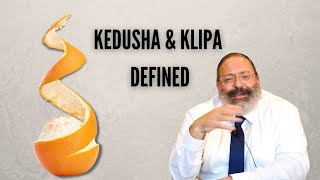
Short Summary
Main recommendation: Recognize that kedusha (holiness, transparency) reveals the divine reality within everything, while klipa (shell, husk, cover-up) conceals it, and judge your thoughts and actions by whether they reflect that truth or obscure it. Rabbi YY Jacobson explains the concepts through the image of a fruit peel or nut shell that protects but also hides what is inside, then applies the distinction to self-talk about being worthless or detached from God.
Key Points
- Kedusha means holiness and is defined as transparency: it makes the true nature of a thing visible.
- Klipa means shell, husk, or peel: it covers and conceals what is inside, as a banana peel protects and hides the fruit or a walnut shell must be broken to reach the nut.
- Klipa is defined as anything that eclipses the truth that everything is a derivative of divine consciousness.
- Negative self-thoughts (being a loser, hopeless, damaged goods, detached from God) are identified as klipa because they hide the truth that you are always one with God.
- The stated truth is that God is everywhere and in everything, giving life to all and present in every one of the body's seventy trillion cells and hundred billion neurons.
- Any thought, emotion, instinct, word, or action that reflects divine love and infinity is kedusha; any that makes you feel separated from infinity is klipa.
Details Worth Noting
- Concrete instructions: No step-by-step procedure is given. The actionable guidance is to examine each thought, emotion, instinct, word, or action and ask whether it reflects that you are a manifestation of divine love and infinity (kedusha) or makes you feel detached, separated, and not part of infinity (klipa). When a negative self-judgment appears, identify its message as klipa and counter it by recalling that you are always one with God.
- The speaker names several self-judgments as examples of klipa: "loser," "hopeless," "nebbish," "schmuck," "unsalvageable," and "damaged goods."
- The speaker references the daily prayer phrase "You give life to everything" as a source of the truth that divine presence is in everybody and everything.
- The distinction is framed through physical analogies (banana peel, orange peel, walnut shell), which the speaker uses to explain how a protective covering can also conceal.
- The video is a spiritual teaching in Jewish mystical terminology; the concepts are presented as religious ideas rather than psychological or clinical advice.
Bottom Line
The core test is whether a thought or action reveals your connection to the divine or hides it, with negative self-talk treated as a concealing shell that must be recognized and looked through.


