digest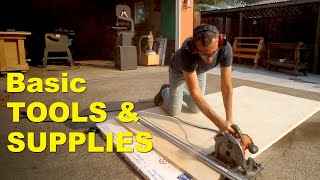
Short Summary
Main recommendation: Start woodworking with a modest, needs-based power tool set, buying used where possible, and add tools only when a project genuinely requires them. The core starter kit covers a table saw, miter saw, jigsaw, circular saw, drill and impact driver, random orbit sander, shop vac, clamps, measuring tools, wood glue, and safety gear. Steve Ramsey, who explicitly states he is not selling anything, frames this as traditional power tool woodworking and excludes CNC, laser, and hand tools.
Key Points
- The table saw is called the "heart of any workshop," enabling rip, cross, and resaw cuts, but it is the most intimidating and dangerous tool for beginners.
- A miter saw complements a table saw by handling thick, long, or bulky stock, since the workpiece stays stationary while the blade moves.
- Buying used tools (Craigslist, Facebook Marketplace, garage and estate sales, flea markets) gives more value, since most power tools are durable.
- Brand loyalty is unnecessary; battery compatibility is described as a marketing talking point rather than a real problem.
- Wood glue, specifically Titebond II, is the primary joining method, with screws used mainly for shop fixtures and jigs rather than nails.
- Sawdust control matters for health and cleanliness; the shop vac should be connected to any tool with a dust port.
Details Worth Noting
- Concrete instructions:
- Buy a drill and an impact driver as a pair, plus a set of drill bits and driver bits.
- Start with three sanding grits for the random orbit sander: 60, 120, and 220. Rarely sand finer than 220 for woodworking.
- Keep a shop vac connected to the table saw and other dust-port tools; vacuum early and often, and keep a broom handy.
- Start with two 24-inch bar clamps and, if possible, a couple of 36-inch clamps. Pipe clamps (half-inch or three-quarter-inch black pipe with swappable fixtures) are an affordable option, and a strap clamp is recommended for every beginner.
- Buy a measuring tape of 12 to 16 feet, not longer, for small projects; a 50-foot tape is only needed for large construction. Add an 18-inch combination square and a framing square.
- Buy a box of inch-and-a-quarter star-head screws, which drive more easily.
- Use a 14-gauge, 15-foot extension cord.
- Wear safety glasses, hearing protection, and an N95-style filter mask with activated carbon filters.
- Buy a tool only when a real project need arises, and begin with a modest collection.
- Table saw safety: Most finger-loss injuries in woodworking happen on table saws; flesh-sensing saws exist but cost much more.
- The speaker relies heavily on rabbet joints, grooves, and dados, and recommends a stack of dado blades.
- Next-level purchases suggested after basics: a router (first upgrade), pocket hole jig, benchtop sanders (disc and spindle), drill press, air compressor with brad nailer, planer, jointer, and a band saw (a large investment), though the speaker no longer owns the planer, jointer, or band saw.
Bottom Line
A beginner can build a capable woodworking setup gradually and affordably by prioritizing safety gear, dust control, clamps, and a few core power tools, and by letting real projects dictate each new purchase. (Note: he also plugs his Weekend Woodworker course and safety video, which should be omitted as promotional content.)