digest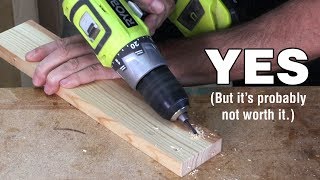
Short Summary
Main recommendation: The speaker prefers using a pocket hole jig to make pocket holes because it gives accuracy, precision, and consistency, though he explains pocket holes can be made without one, and he notes this is not sponsored by Kreg. The speaker explains that pocket holes create strong joints by pairing a flat-bottomed angled hole with a flat-shouldered pocket screw, while toe nailing screws at an angle is generally not recommended for furniture.
Key Points
- Driving screws straight into end grain has poor holding power and can loosen over time, especially on drawers and furniture that see weight, handling, or movement.
- A pocket hole is an angled hole with a wider flat-bottomed counterbore at its mouth, drilled only into the first board, usually with a specialized step bit.
- Pocket screws have a wide flat underside to the head that seats in the pocket, and a self-tapping point that pulls the second board tight.
- Toe nailing (driving screws at an angle without a pocket) is weaker, is prone to splitting near board ends, makes consistent angles hard, and gives no clear feel for when to stop.
- The jig is most worthwhile when there are many pocket holes, since hand-made holes are slow and tedious, according to the speaker's own preference.
Details Worth Noting
- Concrete instructions: To make a pocket hole without a jig, first drill a small angled hole by drilling straight down to start, then tipping the drill at an angle so the bit exits as close as possible to the center of the board's thickness. Next, use a wider bit to make the pocket, taking care not to drill too deep or the screw will go in too far. Then use regular pocket screws. The speaker notes this may be less strong because there is no flat shoulder in the pocket, and it takes practice.
- Concrete instructions: Another option is using the specialty stepped bit freehand, without a jig. Stop drilling as soon as the bit tip pokes through, and expect a practice curve for consistency.
- Concrete instructions: For a budget compromise, the speaker suggests a mini pocket hole jig with its own drill bit (about $20). It requires clamping for each hole but gives clean, accurate holes.
- Concrete instructions: To toe nail without a jig, drill a starter hole downward, tip the drill at an angle toward the other board, clamp the pieces, then drive the screw. The speaker advises against this for woodworking projects.
- The speaker says that if you only have a couple of pocket holes, the freehand method may be worth it, but for many holes the jig is much faster.
- Traditional joinery such as dovetails and mortise and tenons is mentioned as an alternative if you want to avoid mechanical fasteners altogether.
Bottom Line
A jig is the reliable path for repeated pocket holes, while freehand or mini-jig methods suit occasional use if you accept a learning curve and possibly weaker joints.