digest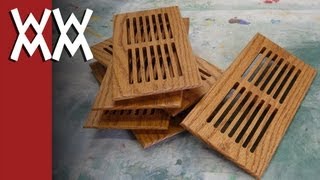
Short Summary
Main recommendation: Build furnace floor vent register covers as a repeatable router-table assembly line, setting up each cut once and repeating it across all pieces. The vents in this project are 5 1/2 inches wide, so off-the-rack lumber of that width works directly. Woodworker Steve Ramsey built six covers this way, inspired by a viewer's photos of floor vents he had made.
Key Points
- The critical dimension is the underside lip that drops into the floor opening, so that part must be sized precisely to fit the hole.
- Before cutting real stock, Ramsey made a full-size template and then a plywood mockup, which served as a setup guide rather than a cutting template.
- Slots are cut with a 1/4-inch straight bit, spaced 1/4 inch apart, using stop blocks on both sides of the fence to finish each slot.
- The perimeter rabbet is removed in two separate passes because the straight bit is 5/8 inch and the rabbet is about 1 inch wide.
- The final edge is softened with a 1/4-inch round-over bit to create a smoother transition to the floor.
Details Worth Noting
- Concrete instructions:
- Draw a full-size template, then build a plywood mockup to confirm measurements before cutting final stock.
- Mark lines on the router table so each fence position can be repeated exactly.
- Set a stop block on the left side of the fence to stop the board at the slot end, then a stop block on the right side to finish that side's slot. Flip and reposition the board to cut all slots with one setup.
- Cut each slot in four passes, raising the bit a little at a time, with the final pass cutting fully through.
- To shift spacing by a half inch, slide the fence back using a half-inch MDF spacer placed against a cut board over the bit, then lock the fence.
- For the rabbet, Ramsey found he preferred moving the board fully across and raising the bit gradually rather than making shallow passes at final height or entering from the side, saying this gave a cleaner cut in his experience.
- Use a quarter-inch MDF guide with a notch over the fence to clean the outside edges; a running vacuum holds it in place without clamps.
- Repeat the procedure on all pieces, then raise the bit slightly and repeat until the final depth is reached.
- Reduce the rabbet to about 1/8 inch thick, then finish with a 1/4-inch round-over bit, moving the fence to the originally marked line.
- Ramsey advises planning each setup for repeatability before starting, since the work is repetitive and an assembly-line approach is efficient.
- Ramsey notes the work is repetitive, and the project was a response to a viewer's request.
Bottom Line
Efficient, repeatable router-table setups with marked fence positions and stepwise passes let a single builder produce matching floor vent covers reliably.