digest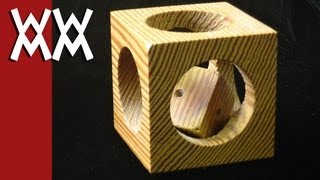
Short Summary
Main recommendation: Make a cube-in-a-cube puzzle from a single solid block of wood (not laminated), using a drill press with a Forstner bit and a fixed stop block to cut the inner cube free. The finished piece is best left unpainted and finished only with oil so the wood grain stays visible.
Key Points
- Use solid wood rather than laminated stock, since visible glue lines would reveal how the piece was assembled and undermine the illusion.
- Drill from all six faces with a fixed stop block so every hole is centered; the stop block is never moved during the procedure.
- Cut in stages: first a shallow depth stop about 1/16 inch above the marked line, then progressively deeper passes until the inner cube nearly releases.
- Free the cube by cutting the last connections with a sharp knife, going with the grain, then finish the edges with sandpaper.
Details Worth Noting
- Concrete instructions:
- Find the center of one face and draw lines to mark it; mark a small X in one corner of each face so every face is drilled in the same orientation.
- Set the drill press to its slowest speed and install a Forstner bit (he used a 2-inch bit for a 3-inch block, but size the bit to your block).
- Clamp a stop block or board to the drill press fence at the exact center point; leave it in place for the whole procedure.
- Draw a square line from one diagonal to the circle's intersection and underline it; set the depth stop about 0.16 inch (1/16 inch) above that line, and do not go deeper, or the bit will cut through the cube.
- Clear shavings from the hole before each cut so the piece sits properly, and keep the X on the same side each time.
- Cut the end grain first (it is tougher and can chip if left for last), then the face grain.
- After all six faces are cut, lower the bit about 0.32 inch and work around each side in short passes, taking it down about half an inch at a time, avoiding breaking through.
- When the cube is nearly free, cut the remaining material with a sharp knife along the grain.
- The speaker says the whole project takes about an hour at the start, though he later says you can get it done in about a half hour.
- The speaker used an oil finish, rubbed over the piece; he advises against polyurethane or paint because the grain is part of the charm.
- He mentions a cube-within-a-cube-within-a-cube variant he has seen but hasn't been bold enough to try.
Bottom Line
A simple, satisfying puzzle that rewards careful, repeatable drill press setup and patient, shallow cuts over speed.