 digest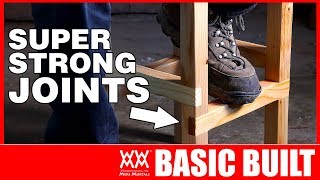
Short Summary
Main recommendation: Build the basic shop stool using half lap joinery cut on a table saw with dado blades, as a beginner-friendly way to learn basic table saw skills. The joints are strong, self-squaring, and reusable in future projects, and the stool can be finished with spray lacquer.
Key Points
- Half lap joints are presented as the core technique, giving a sturdy frame and a reusable skill for later projects.
- Legs are notched in pairs with alternating orientation, so the plan's notch direction on each leg matters for assembly.
- Lap joints take more upfront time for cutting and fitting, but he says it's worth it because the joint is strong and assembly afterward goes quickly and squares itself.
- The seat is made by gluing four boards together, while the frame is assembled with glue and clamps.
Details Worth Noting
- Concrete instructions:
- Cut four boards and square them up, then glue them together for the seat.
- Obtain 2x4s (or 2x2s, which the speaker says would be easier) for the legs and cross pieces, expecting rough spots and selecting good sections.
- Install dado blades in the table saw and raise them to cut about half the thickness of the board.
- Cut a series of notches in each leg, following the plan's orientation since it alternates on every other leg.
- Sneak up on an exact fit on one leg by cutting slowly (better too tight than too loose), lock the fence, then cut the other three legs.
- Adjust the fence to cut notches on the opposite side of two legs, then fit one leg exactly and cut the rest.
- Move the fence to cut a 1-inch notch on the top of each leg, marking each leg so the positions are correct.
- Keep the fence set for the 1-inch notches and cut half laps in the ends of each lower cross piece.
- Shorten one end of each upper cross brace slightly, using a regular saw blade and a stop block instead of the fence so the wood doesn't get trapped.
- Dry fit first: the upper brackets alternate with one short end and one long end.
- Assemble with glue and clamps; to speed up, glue and drive a screw into each half lap.
- Square up the seat while the glue dries, then apply spray lacquer to finish.
- The speaker says this is a rough-and-tumble shop stool, though it may be good enough for home use.
- The stool design uses a seat from four glued boards, which provides a larger glue surface area at the shoulders.
Bottom Line
The stool is a practical beginner project that teaches table saw notching and half lap joinery, and careful fitting plus correct leg orientation are what make it come together.




