digest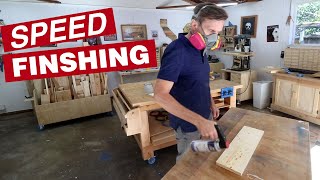
Short Summary
Main recommendation: Use Deft spray lacquer applied in quick, overlapping coats, skip sanding between coats, and buff the final coat with craft paper to get a smooth, professional-feeling finish in under 30 minutes. The speaker says Deft outperforms other brands he has tried, and that the buffing step is what separates an amateur finish from a pro one.
Key Points
- Spray lacquer dries fast enough that a second coat can follow once the first is dry to the touch, often in under five minutes on a warm, dry day.
- Lacquer bonds chemically, so each coat fuses into the previous one and no sanding is needed between coats, unlike polyurethane or varnish.
- The main drawback is cost; a single Deft can is about $14 on Amazon, and the speaker usually buys a six-pack for roughly $64.
- Surface smoothness comes from the finish rather than the wood, so sanding to 120 or sometimes 220 grit is enough.
- Buffing removes dust particles and small bubbles that settle on wet lacquer, and the speaker says the feel of the finish matters more than its appearance.
Details Worth Noting
Concrete instructions:
- Wear a respirator rated for vapors, since lacquer fumes are strong and a regular dust mask is not enough; spray with good ventilation or outdoors if possible.
- Consider a spray-can trigger attachment from a hardware store or home center for better control than pressing the nozzle with a finger.
- Sand the project to 120 grit, or sometimes 220 grit, before the first coat.
- Shake the can for 20 to 30 seconds, then spray in overlapping passes about six to eight inches from the surface. Practice on scrap wood first.
- Start moving the can before it reaches the board and release the trigger only after it has passed the surface, to avoid drips and uneven start and stop points.
- Keep the wrist still rather than swinging it, since swinging puts more finish in the middle and less on the sides.
- Apply extra slow, thin coats to end grain, which soaks up lacquer.
- Apply the next coat once the previous one is dry to the touch; the can says to wait 30 minutes, but the speaker has not found this necessary. Usually three coats is plenty, but you can apply as many as you want.
- Sand between coats only to fix a drip or run, lightly, then recoat.
- After the final coat, buff by wadding up craft paper or a brown paper bag and rubbing firmly, checking the surface by feel with your other hand, until you reach a smooth satin sheen.
Additional context:
- Deft comes in semi-gloss, satin, and gloss; the speaker usually uses satin or semi-gloss and says he can barely tell them apart. Gloss requires a different buffing technique to reach a high-gloss finish.
- Brushing lacquer also produces a good finish but takes more care and attention to apply than spray lacquer.
Bottom Line
Spray lacquer with quick, unsanded recoats and a final paper-buffing step gives a fast, smooth finish that the speaker considers superior to other options he has tried, at the cost of a higher price per can.