digest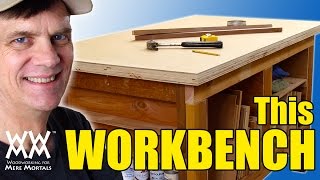
Short Summary
Main recommendation: build a sturdy, sheet-goods workbench by reusing an old workbench top, assembling the frame with pocket screws, and adding a plywood base and a laminated plywood top. The video presents this as a project that frees up significant shop floor space; the 'weekend' framing comes only from the title, not the transcript. The transcript covers the build sequence only in outline, so the exact dimensions and fastener counts are not stated.
Key Points
- Reuse the heavy top from an old workbench as the new bench top, cutting it to size first to make handling easier.
- Build the frame with pocket screws, using them on the long side assemblies and the two center braces.
- Attach the legs and braces with plain screws through adjacent boards where pocket holes are not needed.
- Make the top from two pieces of 3/4-inch plywood glued together, then cover it with hardboard for a smooth working surface.
- Add a lower shelf floor from 1/2-inch plywood pieces, with notches that fit around the legs.
Details Worth Noting
- Concrete instructions:
- Cut the old workbench top to size first, since it is heavy to handle.
- Frame out the two long sides first.
- Cut the legs to the height you want the bench to be, then screw the small leg-bottom pieces to the bottoms of the lid.
- Screw braces into neighboring boards without pocket holes, but use pocket screws on the two center braces.
- Piece together the floor from 1/2-inch plywood, cutting notches so it fits around the legs, then drop the pieces in and screw them down.
- Hold the top rail in place with a couple of screws through the end.
- Install cleats to support the shelves.
- Glue two pieces of 3/4-inch plywood together for the top, add a piece of hardboard, and nail it down.
- If you have enough plywood, the bottom can be made from one or two pieces instead of several.
- The transcript does not give exact board dimensions, leg height, screw counts, or glue type.
- The speaker says the bench gives much more room in the shop, which is the main practical benefit shown.
Bottom Line
Reusing an old heavy top and building a plywood-and-pocket-screw frame is a practical way to get a solid workbench that opens up shop space, though the video skips precise measurements.