digest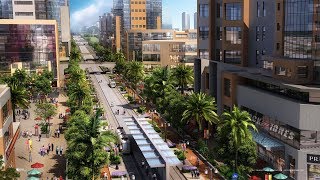
Short Summary
Main recommendation: Build cities around compact, mixed-use, walkable neighborhoods with transit and bike infrastructure, rather than sprawl, since how we shape cities drives climate impact, household costs, and social well-being. The speaker argues sprawl is defined less by density than by isolation, and that the fix is a shift in how we develop, supported by the seven principles he says Chinese national policy has adopted.
Key Points
- Sprawl is defined by isolation: it segregates people into economic and land-use enclaves and separates them from nature, and it can occur at any density, not only low-density periphery development.
- In a California scenario modeling 10 million new residents through 2050, compact streetcar-suburb development produced dramatically lower carbon emissions than sprawl, largely through reduced vehicle miles traveled.
- The speaker says compact development aligns different interest groups (land-conservation environmentalists, farmers, neighborhood groups seeking open space, affordable housing advocates) that previously advocated separately.
- Reducing car dependence lowers household costs; the speaker cites roughly $10,000 per household in annual savings compared with the state median income of about $50,000.
- The speaker names seven principles adopted at high levels of the Chinese government (listed below) that he calls globally universal.
- He is skeptical that autonomous vehicles will reduce traffic, arguing they could increase vehicle miles traveled and revive sprawl.
Details Worth Noting
Concrete instructions:
-
Seven principles for building better cities, as stated by the speaker:
- Preserve the natural environment, history, and critical agriculture.
- Mix: mix incomes, age groups, and land uses, not only land uses.
- Walk: design places people can walk to everything they need.
- Bike: bicycles are the most efficient transportation; China has adopted policy putting six meters of bike lane on every street.
- Connect: build a street network with many routes and many kinds of streets rather than single routes.
- Invest more in transit; there is no silver bullet, and autonomous vehicles will not solve the problem.
- Focus: organize the city's hierarchy around transit rather than freeways.
-
Within the Chongqing example, build walkable transit-station radii (roughly 500 families per block with shops on the street perimeter), preserve ecological green edges along rivers, and create auto-free streets alongside transit corridors.
-
Allocate street space in proportion to use: the speaker argues that if only about a third of people own cars, 70 percent of streets could be car-free rather than giving all streets to cars.
-
In Los Angeles, the speaker describes redirecting investment from highways to transit by targeting strip corridors, adding transit where space allows, and infilling mixed-use development.
-
Los Angeles voted in $400 billion of transit bonds, with zero dollars for new highways, according to the speaker.
-
In China, the speaker cites a reported 12 percent of GDP spent on smog-related health impacts.
-
On autonomous vehicles, the speaker notes surveys in which about 50 percent of respondents said they would not share a taxi, and warns that a 90 percent increase in vehicle miles traveled is possible without sharing, or about 30 percent with sharing.
Bottom Line
Design cities for people on foot, bike, and transit instead of cars, because the same development choices shape emissions, household budgets, and community life at once.