digest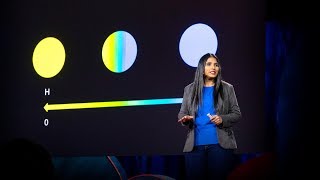
Short Summary
Main recommendation: Treat quantum computing as a new kind of technology, not just a faster version of today's computers, and learn its core idea of superposition, where a quantum bit (qubit) can hold a blend of 0 and 1 rather than a fixed value. The speaker shows this with a coin-flip game in which an IBM quantum computer beat 372 audience-submitted players almost every time, because it kept a superposition alive and then "unmixed" it at the final move. She then argues that the same quantum properties could drive unbreakable encryption, drug-design simulations, and a future quantum internet.
Key Points
- A regular computer stores each bit as a definite 0 or 1, while a quantum bit can have some probability of being 0 and some of being 1, such as 70/30 or 60/40.
- In the coin game, the player's flip or no-flip choice cannot remove the superposition, so the quantum computer can always recover heads on its final move, winning nearly every game.
- Quantum encryption relies on quantum uncertainty: an eavesdropper copying the key would have to break the laws of quantum physics, and banks are already testing this.
- Drug development could benefit because quantum computers operate with the same quantum properties as the molecules they simulate, which the speaker suggests could eventually help with diseases such as Alzheimer's.
- Quantum teleportation of information, enabled by entanglement, is already demonstrated in research labs and could underpin a future quantum internet.
Details Worth Noting
- Concrete instructions: The speaker gives no step-by-step method for the viewer to follow. The only actionable items are the game rules as described: the computer moves first and can flip or not, the player moves next unseen, the computer moves again, and the coin is revealed, with heads winning for the computer and tails for the player.
- The game result was 372 responses collected from TED attendees who chose a circle (flip) or a square (don't flip) by email; the speaker notes the quantum computer lost only a few games due to operational errors.
- The speaker compares quantum computing to the light bulb versus the candle: a quantum computer is a new technology built on deeper physics, not just a more powerful classical machine.
- The speaker's team is simulating a quantum network on a quantum computer and has designed protocols for teleportation among users, efficient data transmission, and secure voting.
- The transcript cites more than 17 billion connected devices globally as the scale that quantum encryption could eventually protect.
Bottom Line
Quantum computers are best understood as a different kind of machine built on quantum uncertainty, and their most concrete near-term promise is in secure communication and molecular simulation rather than general-purpose speedups.