digest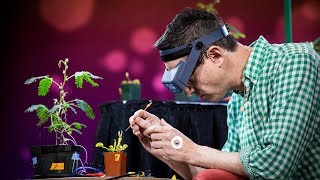
Short Summary
Main recommendation: Treat electrical signaling as a shared language between plants and animals, and use plants as an accessible way to teach neuroscience, since plants lack brains yet still encode and transmit information through action potentials. Greg Gage demonstrates this by recording electrical signals in a Venus flytrap and a mimosa, showing that the flytrap performs a counting computation before closing and that its signal can trigger the mimosa's leaf movement remotely.
Key Points
- The central idea is that plants do not have brains, but they use the same basic electrical language, action potentials, as neurons to move and process information.
- The Venus flytrap counts: a single touch on a trigger hair produces an action potential but does not close the trap; a second touch within roughly 20 seconds triggers closing.
- The flytrap's counting strategy conserves energy, since reopening takes about 24 to 48 hours and each trap only fires a limited number of times before dying.
- The mimosa (Mimosa pudica) responds to touch by sending an action potential down its stem, which changes water pressure in its cells and causes the leaves to fall or curl.
- Gage transmitted the flytrap's electrical signal into a mimosa, causing the mimosa to react as if it had been touched, which he presents as an interspecies plant-to-plant communication demonstration.
Details Worth Noting
- Concrete instructions: No step-by-step procedure for a home experiment is given. The speaker describes how the lab setup works: attach electrodes to the plant (a wire wrapped around the mimosa stem with a ground electrode placed in the soil), tap or touch a trigger hair or leaf, and observe the recorded action potential on screen. He also describes the flytrap's timing rule: a second touch within about 20 seconds is needed to close the trap.
- Arthur Dobbs, royal governor of North Carolina, discovered the Venus flytrap in the swamps behind his house in 1760; Charles Darwin later studied it and called it the most wonderful plant in the world.
- The mimosa's leaf-drop response is not fully understood by science; one proposed reason is that it deters insects or makes the plant less appealing to herbivores.
- Plants use slightly different ions than animals for electrical signaling, though the underlying process is similar.
- Gage's stated goal is to bring graduate-level neuroscience equipment to middle and high school classrooms through Backyard Brains, using plants as an entry point to the brain.
Bottom Line
Plants lack brains but use electrical signals to make rapid decisions and communicate, which makes them a compelling and accessible way to introduce students to neuroscience.