 digest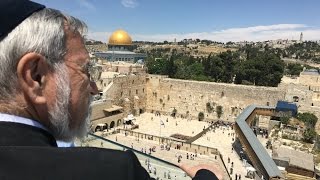
Short Summary
Main recommendation: Rabbi Jonathan Sacks presents Jerusalem as a city of unique, enduring faith, arguing that Jewish hope to return and rebuild it was never lost, and that the city's modern Israeli rule has enabled three faiths to pray together in freedom and peace. He ties this to the 1967 Six Day War, which changed his own outlook on faith and history.
Key Points
- Sacks argues Jewish attachment to Jerusalem was constant: Jerusalem is mentioned about 660 times in Tanakh, and Jews prayed facing it despite the Temple's destruction twice, 23 sieges, and 44 conquests and reconquests.
- He describes Maimonides' view that the Divine Presence was never exiled from Jerusalem, which he presents as the source of its singular status compared with other holy cities like Rome, Constantinople, Mecca, and Medina.
- Sacks recounts his own experience as a Cambridge undergraduate in the weeks before the Six Day War, when Jewish students packed the Thompson's Lane shul to pray amid fears of a second Holocaust.
- He links Rabbi Akiva's response to the ruins of the Temple, drawn from the Mishnah and Gemara, to his conviction that the prophecy of restoration (Zechariah) would be fulfilled, as he believed the prophecy of destruction (Micah) had been.
- He argues that Jerusalem is a rare place where Judaism, Islam, and Christianity are all holy and where those faiths pray together in peace, a situation he says has existed only under Israeli rule in the last 50 years.
Details Worth Noting
- Concrete instructions: The transcript contains no step-by-step instructions, checklists, or actionable advice for the viewer; its content is reflective and historical rather than practical.
- The speaker cites Rabbi Akiva's words that old men and women would again sit in the streets of Jerusalem and children would play there, drawing from the prophet Zechariah.
- Sacks notes that the Temple Mount holds two mosques, that the Old City contains some of Christendom's holiest churches, and that the city is sensitive to real tensions, which he acknowledges.
- He notes Jerusalem's walls were rebuilt by successive conquerors using stones from earlier walls, so the stonework spans many eras.
- Sacks cites a Time magazine listing (a couple of years before the talk) placing Jerusalem among the top five emerging high-tech centers, and connects the city's old and new character to Theodor Herzl's book "Altneuland."
Bottom Line
Sacks presents Jerusalem's significance as rooted in an unbroken Jewish faith and hope, which he believes was vindicated in his lifetime by the city's reunification and its emergence as a place of shared, peaceful worship.



