digest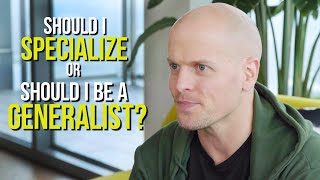
Short Summary
Main recommendation: Be a "specialized generalist" by combining a handful of skills that are rarely combined, rather than specializing narrowly or dabbling in everything. Ferriss argues that pairing two or three valuable, uncommon skills creates a competitive advantage, and that choosing projects based on the relationships and skills they leave behind insures against failure.
Key Points
- Specializing alone only makes sense if you are in the top few percent of your field, like the "LeBron James" comparison; otherwise the bar is extremely high (he cites the top 0.001 percent for basketball).
- Combining two valuable but rare skills, such as a computer science degree plus a law degree, or deep finance/mathematics knowledge plus public speaking, can place you in the top decile of earning power.
- Public speaking, writing, and negotiation are presented as easy multipliers that amplify whatever core skill you have.
- Ferriss credits Scott Adams for the idea of choosing projects based on the skills and relationships they transfer, so that a project that fails still pays off later.
- Warren Buffett is cited as saying his best investment was a Dale Carnegie speaking course, because communication acts as a lever for other skills.
Details Worth Noting
- Concrete instructions: Identify two or three skills you already have or could build, and check whether they are rarely combined in the market (for example, a technical skill plus communication or law). Add public speaking, writing, and negotiation as multipliers on top of your core skill. When choosing a project, pick ones that build transferable skills and relationships, since those carry forward even if the project itself does not succeed.
- Ferriss's own examples: Stumble Upon advising did not work out, but it led to later involvement with Uber. The 4-Hour Chef and the Amazon publishing experiment underperformed, but the relationship with Houghton Mifflin Harcourt (HMH) later transferred to Tools of Titans.
- Podcast interviews during the 4-Hour Chef launch (Joe Rogan, Marc Maron, Nerdist/Chris Hardwick) informed his decision to start his own podcast in 2012–2013.
- Ferriss describes the payoff of these earlier efforts as a return of "a thousand-X, ten-thousand-X" extra later, which is his own characterization rather than a measured result.
- He cites Renaissance Capital as another example of investing success, without further detail in the transcript.
Bottom Line
Rather than choosing between specializing and generalizing, build a narrow combination of complementary skills and treat each project as an investment in transferable skills and relationships, since that is what protects you when individual ventures fail.