digest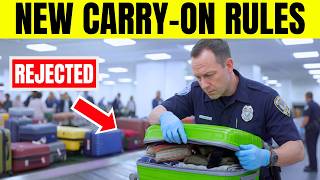
Short Summary
Main recommendation: Treat carry-on rules in 2026 as stricter and less predictable than before, and plan around the most restrictive standard, since a bag that complied in the past may be checked anyway. The video argues that size, weight, the personal item, liquids, electronics, and boarding order are all enforced more tightly, and that compliance alone does not guarantee you keep your bag in the cabin.
Key Points
- Size is now measured absolutely: the carry-on standard is 22 x 4 x 9 in, counting wheels, handles, outer pockets, and bulging seams, and digital scanners replace the old eyeballed metal sizers.
- Weight is now physically measured by scales built into kiosks, security areas, and boarding gates, with no announcement, and excess leads to paying, repacking, or losing the bag.
- A compliant bag can still be checked because overhead bin space is limited, since airlines sell more carry-on allowances than physical spaces.
- Liquid rules are inconsistent across airports, because some use CT scanners that allow liquids to stay inside the bag while others enforce the 3.4-ounce limit.
- Electronics can be required to power on at screening, and power banks are limited by watt-hours rather than size.
Details Worth Noting
Concrete instructions:
-
Measure your carry-on including wheels, handles, outer pockets, and bulging seams against 22 x 4 x 9 in, and treat anything that extends as failing.
-
Before packing, weigh your bag and note that a laptop, chargers, one pair of shoes, and a toiletry kit can bring you close to the limit before any clothing is added.
-
Choose a personal item that fits 18 x 14 x 8 in and fully under the seat in front of you. Prefer a soft backpack or flexible tote, since rigid bags do not compress, and remember that under-seat space varies because some rows have electrical boxes or entertainment hardware.
-
Put all liquids in an accessible exterior pouch every time, since you may not know which scanner your connecting airport uses. Solid shampoo, solid deodorant, and solid perfume avoid the issue entirely.
-
Confirm any power bank's watt-hour rating: under 100 Wh is permitted, 100 to 160 Wh requires airline approval, and above 160 Wh is prohibited.
-
Make sure every phone, tablet, and laptop powers on and is charged, since a device that does not turn on is treated as a potential risk.
-
Board early if you want overhead space, since late boarding raises the chance your bag is checked.
-
The video cites a 2025 Dallas gate incident where a gate agent warned that out-of-order boarding would result in gate-checked bags, and two passengers who tried anyway had their bags tagged.
-
In July 2025 on a Delta flight from New York to Atlanta, fully compliant bags were sent below because bins were full, partly due to deadheading flight attendants carrying multiple bags.
-
A Florida traveler in 2025 left a $65 bronzing spray beside a decorative plant at security and found it still there four days later.
-
The video's key caveat is that the final decision on keeping a bag in the cabin is made after security, not at the checkpoint.
Bottom Line
Assume the strictest version of every rule and board early, because following the rules gets you to the gate but does not guarantee overhead space.