 digest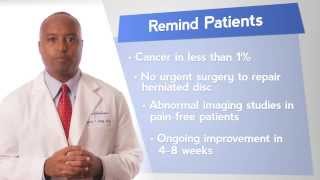
Short Summary
Main recommendation: Most patients with non-specific back pain should not be imaged at first; imaging should be reserved for urgent red-flag findings or for patients who have not improved after four to eight weeks of conservative management and physical therapy. The video explains when to order immediate imaging (within 24 hours, MRI) versus delayed imaging, and gives a way to talk with patients who insist on scans.
Key Points
- Imaging is generally not needed for most new-onset back pain, since about 60 percent of patients feel much better within four weeks, and 70 to 85 percent who are initially unable to work return within one month.
- Imaging is unlikely to change treatment for non-specific back pain and often finds incidental abnormalities: about 20 to 60 percent of pain-free adults under 60 show a herniated disc on MRI, and about 20 percent of pain-free adults 60 and over show asymptomatic spinal stenosis.
- Findings on imaging of pain-free people can lead to unhelpful procedures when they are wrongly linked to symptoms.
- The American Academy of Family Physicians and the American College of Physicians discourage imaging of non-specific back pain without radiculopathy signs on exam.
Details Worth Noting
- Concrete instructions:
- Order an immediate MRI within 24 hours if suspecting cauda equina syndrome (patient reports loss of bladder control or altered sensation, such as toilet paper feeling different on the skin when wiping), metastatic cancer (especially lung, breast, or prostate cancer, or multiple myeloma), or foot drop or significant motor weakness suggesting a neurologic problem.
- Order an urgent MRI for unexplained fevers or active intravenous drug use with abnormal findings suggesting osteomyelitis (local tenderness to gentle percussion, reduced back mobility, or local muscle spasm). Imaging may be delayed one month if another more likely fever source exists and there are no such findings.
- Order urgent AP and lateral lumbar X-rays for patients with a cancer history but no cauda equina signs, to assess vertebral tumor involvement.
- Order urgent AP and lateral thoracic and/or lumbar X-rays for high-impact trauma, ongoing corticosteroid use, or osteoporosis, to check for compression fracture.
- Without urgent symptoms, after four to eight weeks of conservative management (positions to relieve pain, movement exercises, medications, possibly heat or ice) plus a trial of physical therapy, start with an AP and lateral lumbar X-ray if there is no radiculopathy; get an MRI if there is no improvement and neurologic signs suggest a herniated disc with radiculopathy or spinal stenosis.
- Radicular pain without motor weakness does not require an urgent MRI.
- When a patient insists on imaging, the video suggests explaining that less than one percent of back pain cases are caused by cancer; that without motor weakness there is no indication for urgent herniated disc surgery; that abnormal scans are common in pain-free people; and that the natural course is ongoing improvement over four to eight weeks.
- The video is part of a six-part UCLA primary care series aimed at reducing unnecessary imaging and specialty referrals.
Bottom Line
Imaging for back pain should be targeted: order it urgently only for red flags, and otherwise hold off for four to eight weeks of conservative care and physical therapy, since most patients improve without scans.


