digest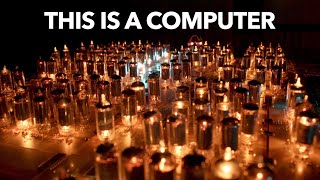
Short Summary
Main recommendation: The video's central idea is that the first electronic computers were built from vacuum tubes, which are essentially glorified light bulbs, and that their evolution from Edison's light bulb through diodes, triodes, and relay-based logic led directly to the electronic switching that made early digital computing possible. The video traces how the vacuum tube triode let computers switch electronically with no moving parts, replacing the noisy, wear-prone relays that preceded it, and how this paved the way for ENIAC in 1945. It also notes that these tubes were power-hungry and unreliable, and that the later move to solid-state silicon was the real breakthrough.
Key Points
- Edison's 1880s observation of one-sided glass discoloration revealed thermionic emission, later called the Edison effect, which became the basis for the diode.
- John Ambrose Fleming's 1904 thermionic diode acted as a one-way valve for current and could convert AC to DC.
- Lee de Forest's 1906 triode added a grid electrode, letting a small grid voltage control a much larger anode current, enabling amplification and, later, switching.
- Claude Shannon's 1937 thesis linked Boolean algebra (true = 1, false = 0) to electric circuits, showing logic operations could be built physically.
- Relay-based machines like George Stibitz's Model K and Bell Labs' Model I did real arithmetic, but mechanical wear, slowness, and noise limited them, while vacuum tubes switched electronically with no moving parts.
- ENIAC (online December 10, 1945) used vacuum tubes to run about 500 operations per second, but its tubes failed about every few days and its longest failure-free run was 116 hours.
Details Worth Noting
- Stibitz's Model K was built in one night at his kitchen table from batteries, light bulbs, and relays, with tobacco-tin pieces used as inputs. It could add two 1-bit binary numbers using two light bulbs as output (0 = no light, 1 = output light, 2 = carry light).
- The Model I, built two years later at Bell Labs, had more than 400 relays and could add two eight-digit numbers in a tenth of a second, though multiplication took about a minute.
- ENIAC weighed 30 tons, drew 175 kilowatts, had its own dedicated generator, and was used for hydrogen bomb calculations. A rumor that Philadelphia lights dimmed when it turned on was described as false.
- The triode's grid works as a switch: very negative voltage stops current, very positive voltage allows maximum current, with no noise and no moving parts.
Bottom Line
Vacuum tube "light bulbs" made electronic computing possible, but their heat, power use, and frequent failure showed why the field needed the solid-state approach that followed.